


Recently updated on August 5, 2026
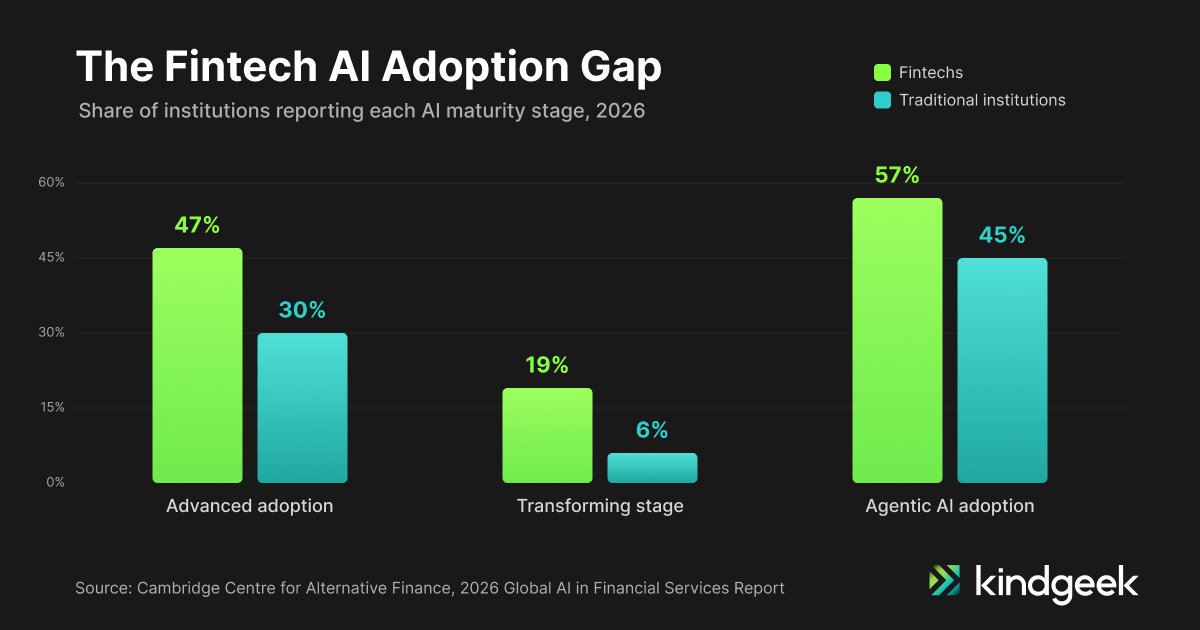
Fintechs report advanced AI adoption at 47%, compared with 30% among incumbent banks, according to 2026 research from the Cambridge Centre for Alternative Finance. This reflects how the two sectors approach technology.
Fintechs can integrate AI into new products and workflows more quickly, while banks balance innovation with complex legacy infrastructure and regulatory requirements.
Generative AI is becoming part of the core technology stack for fintech companies. Success depends on engineering systems that meet the security, compliance, and reliability standards of regulated financial services.
This guide explores the technical decisions behind production-ready AI, including reference architectures, governance models, agentic AI boundaries, and build-versus-buy trade-offs. It draws on Kindgeek’s experience building generative AI features for regulated fintech clients.
For a banking-specific perspective, see our companion piece on generative AI in banking.
- 01Generative AI in Fintech Market Size 2026
- 02What Generative AI Actually Means in Fintech
- 03Generative AI Applications in Fintech
- 04Where Generative AI Fails in Fintech
- 05A Practical Reference Architecture
- 06Governance, Compliance, and Risk
- 07Build vs. Buy
- 08Building Generative AI in Fintech with Kindgeek
- 09FAQ
Generative AI in Fintech Market Trends 2026
Market-sizing estimates for generative AI in fintech vary depending on how the category is defined, with some covering generative models alone and others including agentic AI or the broader AI-in-fintech market. Adoption data provides a more practical signal, showing where companies are deploying these technologies in production.
Eighty-one percent of financial services companies surveyed by the Cambridge Centre for Alternative Finance are using AI in some way. Fintechs are ahead of incumbents in every maturity metric: 47% report advanced adoption compared to 30% for traditional financial institutions, and 19% have reached a “transforming” stage of adoption compared to 6% for incumbents.
The next step after acceptance is investment. According to Deloitte’s research on generative AI pioneers in financial services, early adopters spend at least 20% of their AI budget on generative AI alone, while organizations that are still getting started spend only half that much. Pioneers are also three times more likely to think that generative AI will significantly change their organization within a year.
What Generative AI Actually Means in Fintech
The term gets applied to everything from a support chatbot to a fully autonomous agent. For governance purposes, the difference is important: an agentic system needs controls that are based on its ability to act, while a purely generative system only needs review of what it makes.
| Traditional AI | Generative AI | Agentic AI | |
|---|---|---|---|
| Input | Structured data | Structured or unstructured data | Structured or unstructured data, plus tool access |
| Output | A classification or a number | New content: text, code, a summary | An output, plus an executed action |
| Typical fintech example | Credit scoring, fraud scoring | KYC summarization, adverse-action drafting | Automated case routing, batch reconciliation |
| Failure mode | A wrong number, measurable against ground truth | A plausible-sounding but incorrect output | A wrong action, already executed on a system |
| Oversight needed | Periodic model validation | Human review of outputs before use | An approval gate before every consequential action |
Generative AI vs. Traditional AI
For over a decade, fintech companies have used traditional or predictive AI to score credit, detect fraud, and predict customer churn. These models take structured inputs and return a classification or number, such as “approve,” “decline,” or a risk score.
Generative AI produces new content instead like a document, a summary, a piece of code, or a conversational response.
A predictive model’s output can be validated against ground truth, making errors relatively easy to measure. If a generative model gives you a plausible-sounding but wrong output, it’s harder for the model to catch on its own.
For more on predictive models across the underwriting and fraud stack, see our breakdown of machine learning use cases in banking, and for the wider picture of where AI generally is delivering value, see AI in fintech: key benefits and use cases.
Generative AI vs. Agentic AI
Generative AI produces an output and stops there. That output is used by agentic AI, which can call a tool, change a record, or move a payment through a workflow step on its own.
The practical difference is blast radius. An incorrect KYC summary can be caught during human review. An AI agent can approve a credit limit increase or release a payment hold based on faulty reasoning. By the time someone spots the error, the action has already been taken.
That’s why agentic AI in fintech needs its own approval gates, layered on top of whatever governs the generative model.
Generative AI Applications in Fintech
In 2026, the strongest generative AI use cases in fintech are in fraud detection, credit, compliance, customer service, and software engineering. This is where the business value is clear and risks can be managed.
Fraud Detection & Investigation
Fraud is the most mature generative AI application in fintech, and the one facing the sharpest counter-pressure.
In 2024, Deloitte’s Center for Financial Services projected generative-AI-enabled fraud losses in the US could reach $40 billion by 2027, up from $12.3 billion in 2023, a 32% compound annual growth rate driven largely by deepfake and synthetic-identity schemes.
On defense, generative models help investigators move faster once a transaction is flagged: summarizing a customer’s transaction history into a narrative an analyst can act on in seconds, and correlating signals a rules engine would treat separately.
Mastercard reports that 83% of industry leaders say AI has reduced false positives and customer churn in fraud programs.
The generative layer sits on top of the detection model, turning flagged alerts into investigation-ready case files. These workflows often work alongside robotic process automation, covered in our guide to RPA in finance and banking.
Credit Scoring & Underwriting
Generative AI’s role in underwriting is mostly assistive. It can summarize unstructured financial documents into structured inputs, draft adverse-action explanations, and surface the reasoning behind a score for a human underwriter.
Credit and lending decisions sit inside the EU AI Act’s high-risk category and most fair-lending frameworks, so the decisioning logic stays with an auditable, traditional model. Generative AI’s job is to make that model faster to feed and easier to explain.
KYC/AML & Compliance Automation
In the KYC and AML processes, a lot of papers need to be reviewed. Generative AI is very good at working with unstructured data, like pulling out entity data from identity documents, writing up reports of suspicious activity, and summarizing transaction history for a compliance analyst.
The output still needs to be signed off by a person; regulators want a named accountable reviewer to be on file for AML choices.
The work that an analyst used to do all day, like drafting and extraction, now goes through a generative layer first. This is one of the clearest cases of near-term ROI in fintech.
Customer Service & Financial Assistants
A lot of the first-line fintech help is handled by conversational generative AI. This includes questions about balances and transactions, starting disputes, and giving personalized advice based on a customer’s own account data. If you compare it to rule-based chatbots that fintechs used five years ago, it can read intent and context better. It then sends a full summary to a human agent.
Software Engineering Acceleration
The use case with the least regulatory friction, and some of the fastest returns, sits inside the engineering organization itself. Coding agents now support development, QA, documentation, and operational workflows.
Per the Cambridge Centre for Alternative Finance report we mentioned above, software engineering is among the most common AI use cases in financial services, deployed at pilot stage or beyond by 75% of institutions.
The constraint is governance, including how to control model costs as usage grows, what an agent can access, and who approves AI-generated code before it touches a controlled production path. We explore these topics in our guides to AI Adoption in Fintech Engineering in 2026 and AI in QA automation for fintech CI/CD pipelines.
Where Generative AI Fails in Fintech
MIT’s Project NANDA found that 95% of organizations deploying generative AI report no measurable profit-and-loss impact, with only 5% of pilots reaching real, scaled transformation.
Gartner puts a comparable number on the agentic side: over 40% of agentic AI projects will be canceled by the end of 2027, driven by escalating costs, unclear business value, and inadequate risk controls.
The root cause traces to a handful of recurring, avoidable patterns. Fintech’s regulatory load makes each one more expensive to get wrong than in most other industries.
Pilots Trained on Ideal Data Instead of Production Data
Many AI pilots perform well with clean, curated datasets but struggle once they encounter real customer data. In production, models must handle inconsistent formats, multiple currencies, missing information, and edge cases that never appeared during testing.
MIT’s research identifies this gap between pilot and production as a major reason AI projects fail.
Governance That Doesn’t Evolve with the System
An AI tool may start by generating drafts for human review, then gradually expand to approving actions or triggering workflows automatically. Each increase in autonomy requires stronger governance, access controls, and oversight.
Organizations often expand the system faster than they update these controls, creating unnecessary operational and compliance risk.
Shadow AI Handling Regulated Data
Employees often turn to public AI tools when approved internal systems are slower or less capable. MIT’s research describes this as a “shadow AI economy.” In fintech, it can expose customer financial data to consumer AI services that lack the contractual, security, and audit controls required for regulated environments.
Costs That Grow With Production Usage
Production AI systems require retrieval, validation, monitoring, logging, and other safeguards. Each layer increases the cost of every request. Gartner identifies rising operating costs as a common reason AI initiatives lose momentum after the pilot stage, especially when production usage grows beyond the original business case.
Across all four challenges, the common theme is execution. Successful deployments depend on clear scope, strong governance, and reliable integration with existing systems.
A Practical Reference Architecture
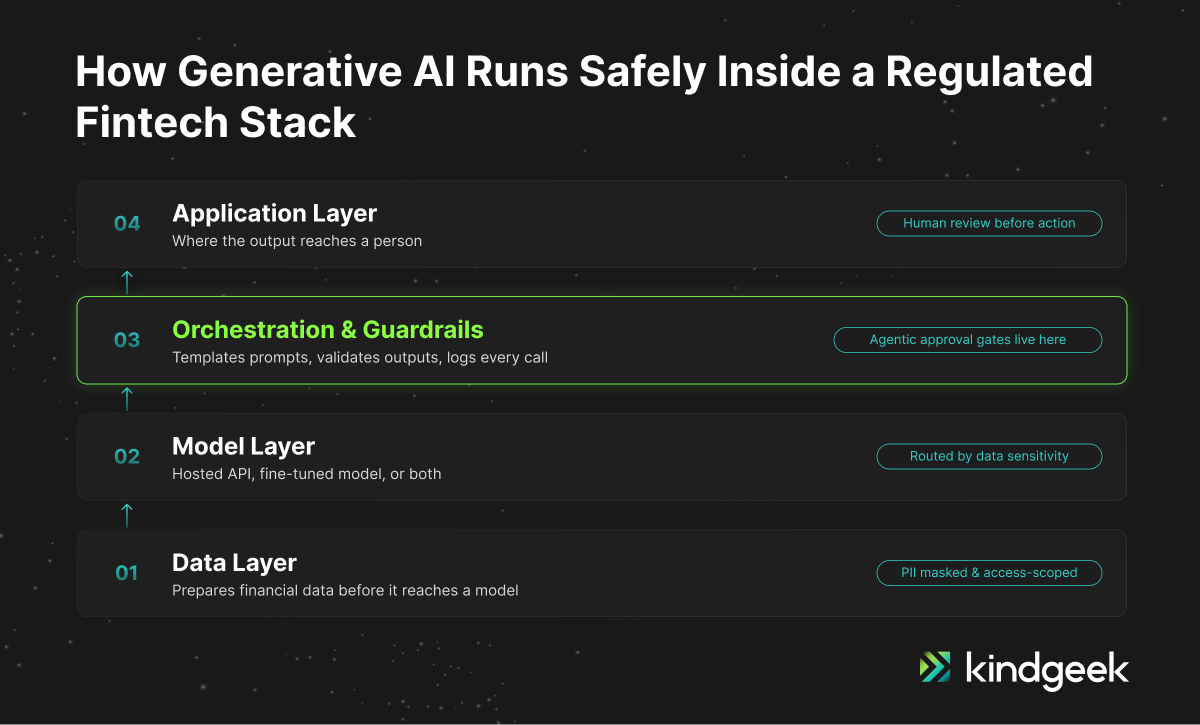
A production generative AI system in a regulated fintech generally breaks into four layers:
| Layer | What It Does | Key Controls |
|---|---|---|
| Data | Prepares financial data before it reaches a model, reusing a fintech’s existing data governance investment | PII masked or tokenized; access scoped by role; a defined boundary on what the model is allowed to see |
| Model | A hosted foundation model via API, a fine-tuned open-weight model on internal infrastructure, or both for different tasks | Fine-tuned or self-hosted for anything touching customer PII; API-based models for lower-sensitivity drafting and summarization |
| Orchestration & guardrails | Templates and version-controls prompts, constrains retrieval, validates outputs, logs every call | This is also where agentic AI’s approval gates live |
| Application | The interface, a support tool, an underwriter’s dashboard, a compliance analyst’s case queue, where the output actually gets used | A human review step enforced for anything touching a regulated decision |
Integrating AI into an existing technology stack often shortens delivery timelines. Learn more in our guide to fintech product engineering.
Governance, Compliance, and Risk
Everything above works in a regulated fintech only when it’s paired with a governance model built specifically for generative AI’s failure modes.
Explainability & Human-in-the-Loop
Every AI-generated output that influences a customer-facing financial decision should have a designated human reviewer with the authority to approve, reject, or override it. That review should also be documented. Regulations such as the EU AI Act require documented human oversight for high-risk AI systems, including AI used in areas such as credit scoring.
Explainability follows the same principle. Regulators need a clear record of the data the model used, the conclusion it produced, and why the human reviewer approved or overrode that outcome.
Prompts and Outputs as Controlled Artifacts
Think of prompts as any other piece of production logic that affects how customers behave. Version them, look over changes, and test them before putting them into use. Keep the same level of discipline with model outputs by writing down the prompt, the input data, and the answer that was created. These records can be used to show why a customer got a certain answer months later during an audit.
When fintechs move from test to production, unmanaged prompt configuration is one of the problems we see most often.
Audit and Model Risk Management
Generative AI introduces a different kind of model risk. A traditional model typically behaves consistently after validation, while a generative model can change when its prompts are updated, a new model version is released, or the provider modifies the underlying system. Some of those changes happen outside the fintech’s direct control.
Managing this risk requires ongoing oversight. Teams should regularly revalidate models, monitor output quality over time, and establish contractual requirements for providers to notify them of significant changes. DORA’s ICT third-party risk framework, which has applied across the EU since January 2025, requires this type of vendor oversight for critical technology providers, including generative AI vendors.
Bias, Hallucination, and Over-Reliance
Bias in generative AI usually comes from the training data. If certain groups are underrepresented or overrepresented, the model can reflect those patterns in the content it generates.
Hallucinations are a different challenge. A generative model can produce an answer that sounds confident and convincing but is factually incorrect. That’s why output validation and retrieval grounding play such an important role in generative AI systems.
Human oversight matters just as much. When people begin to trust AI-generated responses without reviewing them critically, mistakes become more likely to reach customers. We explore these mitigation strategies in more detail in our guide to AI bias mitigation.
Build vs. Buy
Once the architecture and governance model are clear, the remaining decision is whether to build the generative AI layer with an internal team, buy a packaged tool, or bring in a partner who’s built the same pattern before.
| Build In-House | Buy Off-the-Shelf | Build With a Partner | |
|---|---|---|---|
| Time to production | Slowest: full hiring and engineering cycle | Fastest, but limited customization | Faster than in-house, tailored to your stack |
| Regulatory ownership | Full control, full responsibility | Vendor-dependent; may not fit your compliance framework | Shared, with compliance built into the engineering process |
| Cost profile | High upfront, ongoing engineering cost | Lower upfront, recurring license fees | Mid-range upfront, ongoing partnership cost |
| Best for | Teams with in-house AI/ML capacity to spare | Well-understood, low-customization tasks | Regulated products needing compliance-by-design and speed |
Framing ROI Before You Build
The clearest ROI cases are the ones where generative AI removes labor from a well-understood, high-volume task, for example, KYC document review, support triage, code review. Before committing to a build, quantify the current cost of that task in hours, estimate a realistic reduction (rarely total, since human review stays in the loop for anything regulated), and price in the ongoing cost of model usage and governance alongside the build itself.
IDC’s research on agentic AI investments found organizations achieving an average 2.3x return within 13 months, though that assumes the governance and monitoring layer is funded alongside the model from the start.
What to Look For in an Implementation Partner
Three things distinguish a partner who can actually ship a compliant generative AI system:
- direct experience with the regulatory framework a fintech operates under (PSD2 today, DORA’s ICT risk requirements, the incoming PSD3/PSR package)
- a demonstrated track record of production deployments
- engineering practices that treat compliance as part of the build itself.
One of the best ways to evaluate an AI development partner is to ask how they’ve handled model versioning, prompt change control, and audit logging in previous regulated projects. Their approach can reveal whether they understand the engineering and governance requirements of production AI.
Building Generative AI in Fintech with Kindgeek
Building generative AI for financial services requires an engineering approach that balances innovation with security, compliance, and governance. The practices covered throughout this guide become part of the software development lifecycle.
At Kindgeek, we apply these principles when developing generative AI solutions for regulated fintech companies. Compliance requirements such as PSD2, PCI DSS, DORA, and GDPR are embedded into the engineering workflow through automated checks, code reviews, and continuous validation.
Across the projects we’ve delivered, one principle consistently guides implementation: AI can generate, recommend, and automate, while people remain responsible for decisions that affect customers and regulatory outcomes.
If you’re planning a generative AI initiative and deciding whether to build internally, work with a specialized partner, or combine both approaches, we’d be happy to discuss the trade-offs and help you choose the right path.
Exploring generative AI for fintech?
We’re happy to discuss architectures, governance models, and implementation approaches for financial services.
Contact UsWhat is generative AI in fintech?
Generative AI in fintech uses AI models to create new content, such as text, code, summaries, or conversational responses. Fintech companies use it to summarize financial documents, draft compliance reports, power customer support assistants, and help engineering teams write and review code.
How is generative AI different from traditional AI in fintech?
Traditional AI predicts or classifies outcomes, such as credit risk, fraud, or customer churn. Generative AI creates new content based on the information it receives. Because it generates text, code, and other outputs, it requires additional governance, validation, and monitoring in production.
Is generative AI safe to use in regulated financial products?
Yes, when it’s deployed with the right governance and oversight. Common practices include human review for customer-facing decisions, audit logs for prompts and outputs, and ongoing monitoring to ensure models continue to perform as expected.
What does it cost to implement generative AI in a fintech product?
Implementation costs depend on the use case, level of integration, and governance requirements. Many fintechs see the strongest return from document processing, customer support, and engineering productivity. IDC research found that organizations investing in agentic AI achieved an average return of about 2.3× within 13 months.
How do fintechs keep generative AI outputs compliant and auditable?
Successful deployments treat prompts and outputs as controlled assets. Teams keep prompts under version control, log model inputs and outputs, and document human review for decisions that affect customers. These practices support auditability and align with regulatory frameworks such as the EU AI Act.
Is using generative AI in fintech the same as using ChatGPT?
Production AI systems are designed specifically for regulated financial services. They typically include secure integrations, access controls, audit logging, and governance processes that support compliance requirements. Many organizations also add retrieval systems, guardrails, or fine-tune models for their own use cases.
What are the audit risks of generative AI in fintech?
One of the biggest audit challenges is managing change over time. Model behavior can evolve as prompts are updated, new model versions are released, or providers make changes to their systems. Fintech teams address this through regular validation, output monitoring, and vendor oversight aligned with frameworks such as DORA.