


AI payment reconciliation matches payment records across PSPs, acquirers, banks, billing platforms and the general ledger. It identifies discrepancies and flags the ones that need human review.
For example, your PSP reports €104,820 in gross card sales, but your bank receives €93,537.50. The difference may come from processing fees, refunds, chargebacks, foreign exchange (FX) costs and rolling reserves. Reconciliation connects these amounts to the underlying transactions so your finance team can explain the difference before closing the books.
This guide explains how AI-powered matching works, which reconciliation tasks can be automated, how to implement it, and which controls should remain rule-based to meet audit requirements.
- 01Why Payment Reconciliation Breaks at Scale
- 02How AI Payment Reconciliation Works
- 03How AI Matches Payments When the Data Does Not Match Exactly
- 04What AI Payment Reconciliation Can Automate
- 05Turning Exceptions Into a Managed Queue
- 06Rules, Machine Learning, and AI Agents: Where Each Belongs
- 07Real-Time vs. Batch Reconciliation
- 08How to Automate Payment Reconciliation With AI
- 09Metrics That Prove It Works
- 10Risks, Controls, and Where Humans Stay in the Loop
- 11Build, Buy, or Blend
- 12Where AI Payment Reconciliation Is Heading
- 13Build Your Reconciliation Layer With Kindgeek
- 14Frequently Asked Questions
Why Payment Reconciliation May Break at Scale
Reconciliation is straightforward when you work with one acquirer and one currency. Add a second PSP and three settlement currencies, and matching transactions becomes much more complex, even if transaction volume stays the same.
Payment Data Is Spread Across Multiple Systems
A single sale can appear in five different places: as an order in the billing platform, as an authorisation and capture in the PSP dashboard, as a line in a settlement batch, as part of a combined bank deposit, and as a receivable in the ERP.
Each system uses its own identifiers, timestamps and currency formats. Some report amounts in minor units, such as cents, while others use major units, such as euros. Unless the data is standardised during ingestion, these differences can lead to incorrect totals. Kindgeek’s engineers explain why this matters in why fintech QA needs domain experts.
Why Processor Payouts Differ from Bank Deposits
The difference between a processor payout and a bank deposit usually comes from legitimate deductions. The processor’s payout file lists these adjustments, while the bank statement shows only the net amount received.
For a mid-sized merchant with a two-day settlement cycle, the figures might look like this:
| Settlement line | Amount (EUR) |
|---|---|
| Gross card sales, 14–15 March (2,180 orders) | 104,820.00 |
| Refunds processed in cycle | −3,140.00 |
| Chargebacks and dispute fees | −615.00 |
| MDR, interchange and scheme fees | −2,114.60 |
| FX conversion spread | −412.90 |
| Rolling reserve withheld | −5,000.00 |
| Net payout received by bank | 93,537.50 |
Your billing system records 2,180 individual orders, while your bank statement shows a single deposit. Six settlement entries explain the difference, each linked to the orders it covers.
Fees, Refunds, Chargebacks and FX Complicate Reconciliation
Four common issues account for many reconciliation exceptions:
- Timing differences. A refund issued on the 31st may be deducted from the next payout. The cash balances eventually match, but the amounts fall into different reporting periods.
- Late-arriving disputes. A chargeback can arrive weeks after the original sale, affecting a payout that has already been reconciled and closed.
- FX differences. The PSP converts currencies using its own rate at a specific time, while the ledger uses the daily exchange rate. The resulting differences, sometimes just a few cents, can recur with every settlement.
- Partial and split payments. One invoice may be paid through three transfers, or one transfer may cover eleven invoices. Simple one-to-one matching rules cannot handle these cases reliably.
Exception Handling Determines How Quickly You Can Close the Books
Most transactions match without much effort. The remaining exceptions take longer because someone must investigate the discrepancy, identify its cause and decide how to record it.
This work can affect how quickly finance teams close the books. APQC’s research on the annual close found that top-performing organisations complete the process in 10 days or less, compared with a median of 18 days and 35 days for the slowest performers. APQC recommends reconciling complex accounts monthly to prevent unresolved discrepancies from accumulating.
How AI Payment Reconciliation Works
AI-powered payment reconciliation works as a seven-stage pipeline, from collecting payment data to posting reconciled entries to the general ledger.
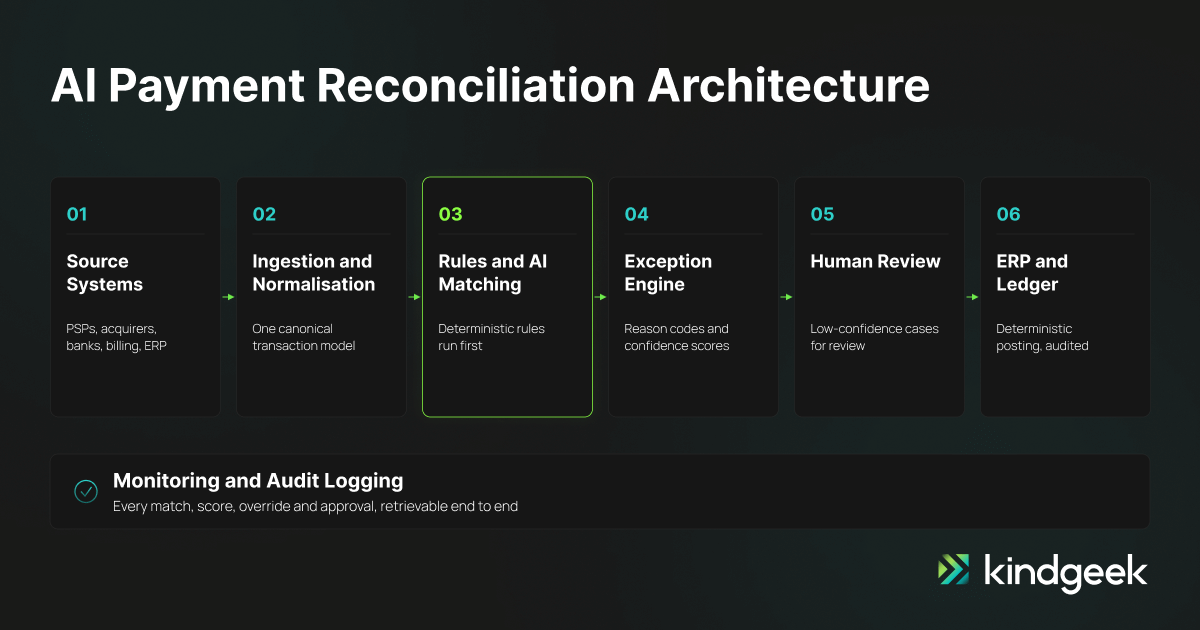
- Collect. The system gathers settlement reports and payout files from PSPs and acquirers, camt.053 and camt.054 statements from banks, invoices from billing systems, and journal data from the ERP. Data comes in through APIs, SFTP or webhooks. Our guide to financial API integration covers integration patterns suited to production systems.
- Normalise. All records are converted into a common transaction format, with consistent minor units, UTC timestamps, fee categories, counterparty names and currency codes.
- Enrich. Each record is linked to relevant orders, invoices, customers, payout batches and settlement dates. This gives the matching process the context it needs to identify related transactions.
- Match. The system applies deterministic rules first, resolving straightforward matches. AI then evaluates the records that those rules cannot match confidently.
- Classify exceptions. Unmatched records are assigned a reason, such as a missing deposit, fee discrepancy, duplicate capture or unapplied refund. This helps prioritise the exceptions that need attention.
- Escalate. Matches with low confidence are sent to a designated reviewer, along with the supporting evidence needed to investigate them.
- Post and log. Reconciled entries are posted to the general ledger. An immutable audit trail records each match, confidence score, manual override and approval.
How the Components Work Together
The process starts with data from PSPs, acquirers, banks and billing systems. An ingestion and normalisation layer prepares the records for a rules engine and an AI matching layer. An exception engine collects unresolved items, and human reviewers handle cases that need further investigation. Once resolved, the entries are posted to the ERP or general ledger.
Monitoring and audit logging cover the entire pipeline. Kindgeek builds these components as separate, independently testable services. This means a change to the fee classification logic can be tested and deployed without affecting the other stages.
How AI Matches Payments When the Data Does Not Match Exactly
Rule-based tools rely on exact reference matches, so they fail when a reference is incorrect, incomplete or missing. AI matching can use other available transaction details to identify likely matches.
| Technique | What it uses | Best for | Output |
|---|---|---|---|
| Deterministic rules | Exact reference, amount, date | Structured ISO 20022 references, invoice IDs | Auto-match, no review |
| Tolerance rules | Amount and date windows | Rounding, FX cents, settlement lag | Auto-match within policy |
| Fuzzy matching | String similarity, partial references | Mistyped, truncated or mangled references | Scored candidate |
| Machine learning matching | Historical pairs, payer behaviour, amount and timing patterns | Many-to-many, recurring payers, split payments | Ranked candidates |
| Language models | Free-text narratives, remittance advice, emails | Unstructured references | Extracted structured fields |
Structured Payment References Make Matching Easier
ISO 20022 includes invoice numbers, creditor references and payment-party details in defined fields rather than free-text descriptions. According to SWIFT, structured remittance information speeds up reconciliation and improves straight-through processing.
Major payment systems are adopting the standard. On 14 July 2025, the Federal Reserve moved the Fedwire Funds Service to ISO 20022 in a single-day transition. U.S. Bank highlights the same issue from the corporate perspective: unstructured remittance data makes invoice matching more difficult, while structured formats make it easier to identify the invoices behind a payment.
When payment data arrives in a consistent format, the reconciliation system needs less logic to interpret it.
Fuzzy and Probabilistic Matching
Payment references are not always exact. For example, a reference recorded as INV 10 44 7 instead of INV-10447 can still match the correct invoice through string-similarity scoring.
Probabilistic matching considers additional signals, including how closely amounts and dates align, how similar the counterparty details are, and whether the transaction fits historical patterns. These signals contribute to a confidence score that helps the system rank potential matches.
Historical Patterns and Transaction Context
Machine learning models can learn from matches confirmed by your finance team. For example, a customer might pay three invoices in a single transfer on the 12th of each month, applying a 2% early-payment discount. Once the model has seen enough confirmed examples, it can recognise similar transactions and suggest the corresponding matches.
Additional context helps narrow down the candidates before scoring begins. This includes relationships between entities, membership in the same payout batch and expected settlement windows.
Extracting Information from Unstructured Payment References
Bank payment descriptions often contain inconsistent or incomplete information. Company names may be truncated, invoice numbers combined into a single string, or deduction reasons included in free text. Remittance advice may also arrive separately by email.
Language models can extract this information into structured fields, such as payer names, invoice numbers and deduction reasons. The model interprets the text, while established rules and authorised reviewers determine how the transaction should be recorded. Our guide to generative AI in fintech explores this division of responsibilities.
Confidence Scores and Matching Thresholds
Each AI-generated match receives a confidence score. Your reconciliation policy determines what happens next: which matches can be processed automatically, which require review and which remain unresolved.
For example, an initial configuration might use these thresholds:
- Above 0.95: Match automatically and post the entry.
- 0.80–0.95: Send for one-click review.
- Below 0.80: Add to the exception queue with suggested matches for investigation.
These thresholds depend on the risk and characteristics of each payment flow. High-value transactions may require stricter thresholds, while high-volume, low-value transactions may support more automation, provided the controls and risk limits allow it.
What AI Payment Reconciliation Can Automate
- Transaction-to-invoice matching, including partial, split and consolidated payments.
- PSP payout-to-bank-deposit reconciliation, with the full fee and reserve bridge reconstructed.
- Fee and commission verification against contracted rates, which surfaces overcharging as it happens.
- Refund and chargeback reconciliation across cycle boundaries, including representment outcomes.
- Multi-currency and FX reconciliation, isolating genuine rate variance from booking errors.
- Settlement reconciliation between scheme, acquirer and internal ledger positions.
- Duplicate, missing and late transaction detection, the leading indicator of payment leakage.
- Suspense account clearing, matching ageing unidentified receipts back to source.
Turning Exceptions Into a Managed Queue
Exception handling is where the workload concentrates. AI turns the queue from a list of unmatched rows into a prioritised, explained one.
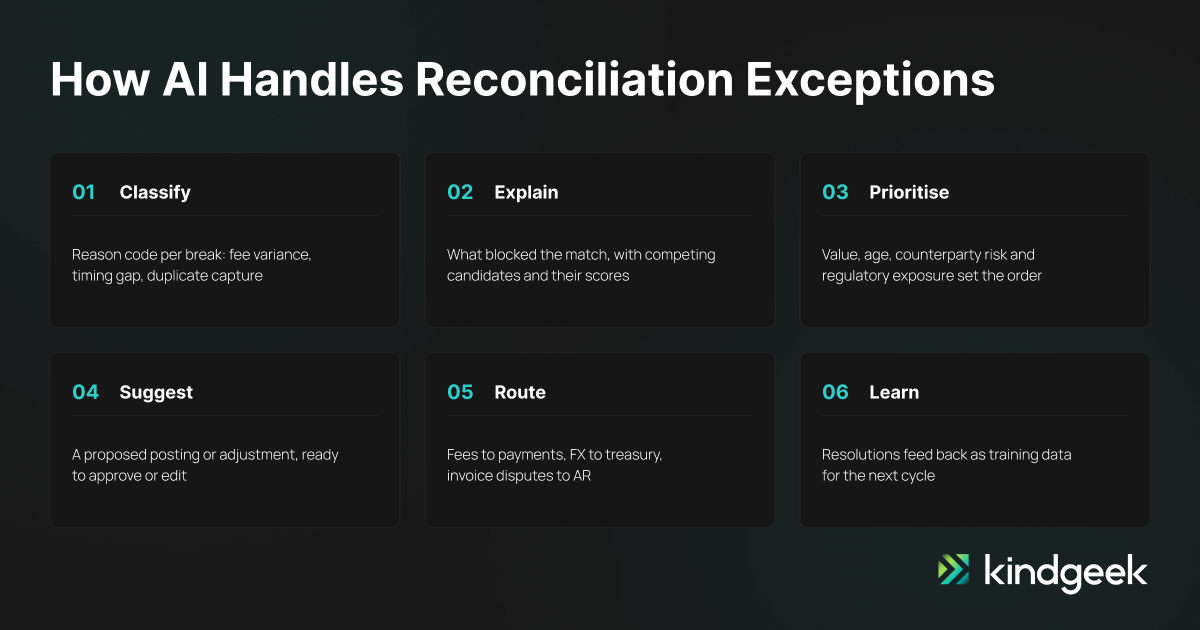
- Classification. Each exception gets a reason code: missing deposit, fee variance, FX difference, duplicate capture, timing gap. Similar cases then batch together.
- Explanation. The system sets out in plain language what blocked the match, with the competing candidates and their scores.
- Prioritisation. Value, age, counterparty risk and regulatory exposure decide what a reviewer sees first.
- Suggested resolution. The system proposes the posting or adjustment; the reviewer approves, edits or rejects it.
- Routing. Fee disputes go to the payments team, FX breaks to treasury, invoice disputes to AR.
- Learning. Resolutions feed back as training data, so recurring exception types shrink over time.
Rules, Machine Learning, and AI Agents: Where Each Belongs
These are four layers with distinct jobs.
| Layer | Job | Why it belongs there |
|---|---|---|
| Deterministic rules | Exact and tolerance matching, posting logic, controls | Reproducible, explainable, testable, auditable |
| Machine learning | Candidate ranking, anomaly detection, pattern recognition | Handles variation that rules cannot enumerate |
| Generative AI | Reading unstructured text, drafting exception explanations | Strong at interpretation, weak as a system of record |
| AI agents | Gathering evidence, chasing missing data, orchestrating the workflow | Removes investigation legwork, under supervision |
Financial posting should remain deterministic: AI proposes matches, while predefined rules and authorised reviewers determine how transactions are recorded.
This approach aligns with how AI is being adopted across financial services. A survey by the Bank of England and FCA found that 75% of firms were already using AI. Of the reported AI use cases, 55% involved some autonomous decision-making, while only 2% were fully autonomous.
The Financial Stability Board also identifies human oversight as a core element of responsible AI adoption. For payment reconciliation, this means using AI to identify likely matches and prioritise exceptions while keeping financial posting subject to established controls and appropriate human review.
Real-Time vs. Batch Reconciliation
Traditional end-of-day and period-end reconciliation assumes payments move on business days and settle in batches. Instant payment systems operate around the clock.
Under the EU Instant Payments Regulation, euro-area payment service providers had to receive instant credit transfers from 9 January 2025 and send them from 9 October 2025, making instant euro payments a standard service across the EU. With payments settling continuously, a once-daily reconciliation cycle can lag behind actual cash movements by almost 24 hours.
Continuous reconciliation is particularly useful for businesses managing prefunded or safeguarded accounts, marketplaces making frequent seller payouts, or treasury teams that need up-to-date intraday cash positions. Batch reconciliation remains suitable for monthly fee statements and other payments settled on fixed schedules.
Many businesses use both approaches: continuous matching for payment flows and periodic reconciliation for accounting controls.
How to Automate Payment Reconciliation With AI
The hard part of how to automate payment reconciliation with AI is sequencing. Here is the order we work in:
- Mapping the money flow. We document each path from customer payment to ledger entry: systems, file formats, cut-off times and the fee deductions on each hop.
- Baselining the metrics. We measure today’s auto-match rate, exception volume, resolution time and close duration. That baseline is what later proves improvement and funds the next phase.
- Connecting the systems. We build or buy the connectors to your PSPs, acquirers, banks, billing and ERP, then normalise everything into one transaction model before writing a line of matching logic.
- Writing the deterministic rules first. Exact-reference and tolerance matching clears most volume wherever references are structured, and that logic stays testable.
- Adding AI matching in shadow mode. We run it alongside your existing process for one or two full cycles, compare its proposals against human decisions, and measure the false match rate before anything posts automatically.
- Setting confidence thresholds and approval policies. You define the auto-post, review and escalate bands by transaction value and risk, and we record who may override what.
- Monitoring, retraining and extending. Accuracy gets tracked by exception type, resolved cases feed back as training data, and scope grows one payment flow at a time.
At Kindgeek, shadow mode is a required step before automated posting goes live. The system processes your transactions and proposes matches without posting any entries, allowing the team to measure how often it matches transactions incorrectly. Those results help set the confidence threshold for automatic posting.
When evaluating AI-powered payment reconciliation, ask vendors to demonstrate shadow-mode results using your own transaction data, not just sample data from a product demo.
Metrics That Prove It Works
Eight figures make the result auditable:
| Metric | Definition | What to watch |
|---|---|---|
| Automatic match rate | Transactions matched automatically, start to finish | Rising, while false matches hold at zero |
| Exception rate | Share of transactions entering the queue | Falling, broken down by reason code |
| False match rate | Incorrect matches posted to the ledger | Target zero; investigate every occurrence |
| Manual review rate | Share routed for human approval | Falling as thresholds and models mature |
| Mean time to resolve | Average age of a closed exception | Falling; spikes reveal upstream data breaks |
| Reconciliation cycle time | Hours from data availability to reconciled position | Hours once continuous matching runs |
| Unreconciled value ageing | Value open beyond 7 and 30 days | Shrinking tail; aged breaks become write-offs |
| Cost per reconciled transaction | Fully loaded cost divided by volume | Falling as volume grows on flat headcount |
Risks, Controls, and Where Human Review Is Needed
- Poor source data. Inconsistent references and truncated payment descriptions limit how many transactions the system can match. Improving data quality at the source often has a greater impact than further model tuning.
- Many-to-many matching. Matching eleven invoices against three transfers and a credit note remains complex. These cases stay in the review queue even after simpler transactions can be processed automatically.
- Incorrect matches going unnoticed. A false match that gets posted can be more damaging than an unmatched transaction flagged for investigation. The system should prioritise accuracy and flag uncertain cases rather than force a match.
- Legacy integration. Fixed-width files, overnight batch processing and ERPs with limited API support can constrain the integration architecture more than the choice of AI model.
- Explainability. Auditors may need to see the transaction data, confidence score, applicable rule or model version, and approver behind an automated match. Each should be recorded and available for review.
- Security and privacy. Payment data may fall under PCI DSS and GDPR requirements. Data minimisation, tokenisation and access controls should be considered from the start of the design process.
- Over-automation. Disputed deductions, contractual fee disagreements and related-party transactions often require judgement. These cases should remain with authorised staff.
The core controls are straightforward: documented confidence thresholds, separation of matching and approval responsibilities, an immutable decision log, and periodic independent reviews of automatically matched transactions.
Build, Buy, or Blend
| Option | Choose it when | What you get |
|---|---|---|
| Native ERP reconciliation | One acquirer, one or two currencies | Matching that ships with the ledger, already integrated |
| Specialised AI reconciliation software | Standard payment stack, speed to value is the priority | A working fuzzy-matching engine in weeks, inside the vendor’s data model |
| Custom build | Multi-PSP, marketplace or regulated flows with unusual settlement logic | Matching logic shaped to your own fee schedules and payout rules |
| Hybrid | Multi-PSP volume on a ledger that already works | Bought connectors and ledger, with the matching and exception layer built to fit |
Choose by how unusual your settlement logic is. Where fee schedules, payout rules and reserve policies follow market standard, buy: the vendor model will fit and you keep the engineering budget for something else. Where that logic encodes how you make money, build the matching and exception layer and buy everything around it.
For businesses working with multiple PSPs, a hybrid approach is often the most practical option. Kindgeek builds this on top of the client’s existing ledger and integrations, combining rule-based controls with AI matching where needed.
Where AI Payment Reconciliation Is Heading
Four shifts are already visible. Matching is becoming context-aware, drawing on relationships and history alongside references. Reconciliation is moving from periodic to continuous as instant rails become the default. AI agents now run exception investigations end to end, pulling the settlement file, retrieving the dispute record and drafting the explanation. And detection is turning predictive, flagging likely payment leakage before the period closes.
Autonomous reconciliation is the label attached to this direction. The realistic destination is high autonomy under explicit human governance, where machines handle volume and people own the judgement calls and the controls.
Build Your Reconciliation Layer With Kindgeek
Kindgeek has spent over a decade building payment and banking infrastructure, from white-label banking platforms to custom ledgers, for licensed fintechs, PSPs and neobanks.
Kindgeek builds the ingestion, matching and exception-handling layers that connect your payment providers to your ledger. Our AI transformation services also cover the discovery and architecture work needed before implementation. We start by measuring the cost of your current reconciliation process to identify where automation can make the biggest difference.
Reconciling across multiple PSPs, banks and currencies?
Kindgeek designs AI payment reconciliation systems with deterministic posting controls, full audit trails and human review where it belongs. Contact us to scope your reconciliation flows.
Contact usWhat is AI payment reconciliation?
AI payment reconciliation applies machine learning and language models to match payment transactions across PSPs, acquirers, banks, billing systems and the general ledger, then classifies the remaining breaks. It extends rule-based matching by scoring likely pairs where references are missing, incorrect or unstructured. The output is a confidence-scored match, which a rule or a person then turns into a posting. In practice it runs as a pipeline: ingestion, normalisation, matching, exception management, ledger posting.
How do you automate payment reconciliation with AI?
We start by mapping every path from customer payment to ledger entry and baselining the current auto-match rate, exception volume and close duration. Next we connect the PSPs, banks, billing platform and ERP, and normalise all of it into a single transaction model. Deterministic rules come first, since exact-reference and tolerance matching clears most volume, and AI matching takes the remainder. The AI layer then runs in shadow mode for one or two full cycles, you set confidence thresholds for auto-posting versus review, and scope grows one payment flow at a time.
Can AI match payments with missing or incorrect references?
Yes, and those cases are the reason for the AI layer. Where a reference is truncated, mistyped or absent, the system falls back on amount proximity, date windows, counterparty similarity, historical payment behaviour and free-text bank narratives. A payment reconciliation AI model combines those signals into a confidence score and proposes the most likely candidate, score attached. Low-confidence proposals reach a reviewer with the evidence attached, so the context sits in one place.
Can AI reconcile processor fees and FX differences?
It can, and fee reconciliation is where overcharging surfaces. The system reconstructs the bridge between gross sales and net deposit, covering interchange, scheme fees, MDR, refunds, chargebacks, reserves and FX spread, then ties each deduction to the underlying transactions. It then checks effective rates against your contracted schedule and flags the variance. For FX, it separates genuine rate and timing variance from booking errors, so only the real differences reach your team.
Can payment reconciliation be fully automated?
Most of it can. Clean, well-referenced flows routinely reach high automatic match rates, and continuous matching removes the period-end crunch. Disputed deductions, contractual fee disagreements, related-party items and anything turning on accounting judgement still need a person, and regulators expect meaningful human oversight of AI in financial processes. The realistic target is high autonomy with explicit governance: AI handles your volume, your people own the judgement and the controls.