


A one-percentage-point increase in authorization rates can recover $10 million in annual revenue for a merchant processing $1 billion a year, according to Worldpay.
AI helps payment providers improve approval rates by selecting the most promising route for each transaction, improving payment data and deciding when to retry declined payments. The issuing bank still makes the final approval decision, but these adjustments can increase the chances of approval.
This article explains how AI payment authorization optimization works and how to measure its impact.
Key Takeaways
- The issuer makes the final approval decision. AI improves the chances of approval: it adjusts the route, transaction data, credentials, authentication method and retry timing.
- Overall authorization rates can hide which issuers and markets have recoverable declines.
- Routing, network tokens, smart retries and 3D Secure (3DS) each improve a different part of the authorization process.
- Visa charges fees for retrying hard declines. Mastercard charges for excessive retries too.
- Net approved revenue per attempt, measured alongside fraud and chargebacks, shows whether a model delivers results.
- The US and UK have different requirements. UK businesses need to consider Strong Customer Authentication (SCA) and its exemptions. US merchants have no such requirement and more debit routing choices.
- Vendor claims of higher authorization rates are more credible when backed by a control group.
- 01What Is AI Payment Authorization Optimization?
- 02Why Payments Get Declined
- 03How AI Improves Payment Approval Rates
- 04What Data AI Uses to Optimize Payment Authorization
- 05How Real-Time AI Authorization Decisioning Works
- 06AI Models and Optimization Techniques
- 07How AI Reduces False Declines Without Increasing Fraud
- 08AI for Payment Authorization Across Payment Scenarios
- 09AI Payment Authorization in the US vs. UK
- 10How to Measure and Test AI Authorization Performance
- 11Rolling Out Authorization Optimization: Steps and Practical Guidance
- 12Build vs. Buy AI Payment Authorization Technology
- 13Real-World Examples
- 14What Comes Next for AI Payment Optimization
What Is AI Payment Authorization Optimization?
AI payment authorization optimization means using machine learning to improve payment approval rates. MSPs, acquirers, and merchants can analyze transaction data and make better decisions. Increasing legitimate transactions without increasing fraud or processing costs is the goal.
How Payment Authorization Works
- The customer submits a payment.
- The PSP sends the transaction details to its acquirer or processor.
- The acquirer formats them into an ISO 8583 message. It sends it through Visa, Mastercard or another card network to the issuing bank.
- The issuing bank decides whether to approve. It sends its response back to the merchant.
According to Stripe, ISO 8583 defines up to 128 data fields, and each issuer decides how to interpret and combine them. That’s why data quality matters. The more accurate and complete the information, the easier it is for the issuer to approve a valid payment.
Authorization Rate vs. Approval Rate vs. Acceptance Rate
Definitions vary by provider. Stripe defines authorization rate as the share of submitted transactions that the cardholder’s bank accepts. Checkout.com publishes an acceptance rate alongside it and recommends that figure for benchmarking PSPs.
| Label | Open question in the definition |
|---|---|
| Authorization rate | Do payments blocked by fraud rules before the network count in the denominator? |
| Approval rate | Does it cover first attempts only, or the result after retries? |
| Acceptance rate | Do 3DS abandonment and technical failures count as misses? |
What AI Controls vs. What Issuers Decide
Merchant-side AI improves the payment request itself. It can choose the acquirer and route, enrich transaction data, select network tokens and decide when to retry a declined payment.
The issuer still makes the final call, often with its own AI. For example, Mastercard’s Decision Intelligence scores each transaction in real time to help banks assess payment risk.
These are separate systems. Merchants can use issuer approval patterns to understand how their transactions are assessed, but they cannot control the issuer’s model or its decisions.
Why Payments Get Declined
Declines split into permanent and recoverable groups.
Hard Declines vs. Soft Declines
Stripe’s guide groups most declines into insufficient funds, wrong or outdated card details, and suspected fraud. Many issuers also return the generic code 05 (do not honor). Some use it for almost every decline, which hides the real reason.
Visa sorts decline codes into four categories. According to PayPal’s May 2026 guidance on Visa network rules, Category 1 declines are hard and should never be retried. Categories 2–4 are soft. Eligible ones can be retried up to 20 times within 30 days. Limits and fees can vary by card scheme program, so check current network guidance.
Mastercard issuers can also attach merchant advice codes that say whether and when to retry.
Where the Recoverable Losses Hide
| Decline type | Typical example | Recoverable? | What AI can do |
|---|---|---|---|
| Hard decline | Stolen card, closed account | No | Ends retries and offers another payment method |
| Soft decline | Insufficient funds, issuer unavailable | Often | Times the retry or switches route |
| Outdated credential | Expired or reissued card | Yes | Network token or account updater |
| False decline | Genuine buyer flagged as fraud | Yes | Sharper risk signals and step-up authentication |
| Authentication gap | Issuer expects 3DS and receives none | Yes | Triggers 3DS when it helps |
| Technical failure | Processor or issuer outage | Yes | Fails over to another route |
| Cross-border or issuer-specific | Foreign acquirer, cautious issuer | Sometimes | Local acquiring and issuer-specific message tuning |
How AI Improves Payment Approval Rates
AI uses five main approaches to improve approval rates, each targeting a different part of the payment process.
Intelligent Payment Routing and Acquirer Selection
Worldpay argues that static routing rules send payments down the same paths even when approval rates dip. AI routing instead scores each payment against live issuer and network performance and picks the route most likely to approve.
Authorization Message and Transaction Data Optimization
Complete requests give issuers more to verify. Stripe says that passing postal code and CVC can improve approvals in the US and UK.
Stripe’s Adaptive Acceptance model goes a step further. It tests small variations in the request, such as how customers type a UK postal code, across many issuers at once and learns which treatment suits which bank.
Network Token and Credential Optimization
Cards can expire or be replaced, but network tokens can remain valid when banks issue new cards. This reduces declines caused by outdated card details and can improve authorization rates.
Card account updater services provide another way to prevent these declines.
Smart Retries and Decline Recovery
Smart retry models analyse issuer behaviour, time of day, location and payment type to decide when to retry a declined payment. Worldpay reports an average 9.3% improvement from retry and credential tools, although it does not specify the starting approval rate.
Card networks limit the number of retries. The model must follow these limits and know when to stop retrying.
3D Secure and Authentication Optimization
Using 3DS selectively can improve approval rates. Worldpay’s Authentication Optimization Service assesses each payment and decides whether to apply 3DS or send it directly for authorization. This helps avoid unnecessary authentication steps
What Data AI Uses for Payment Authorization
Models rank their options from the signals below.
| Signal group | Examples | Decision it informs |
|---|---|---|
| Issuer and card | BIN, scheme, debit or credit, card country | Route, message variant |
| Country and route | Cardholder country, currency, acquirer location | Local or cross-border acquiring |
| Payment context | Amount, merchant category, first payment or stored credential | Authentication path, retry policy |
| Outcome history | Past approvals and declines by issuer and cohort | Route ranking, retry timing |
| Risk signals | Device, velocity, email, authentication result | Risk threshold, step-up |
| Live performance | Processor latency, issuer response patterns, outages | Failover, re-ranking |
| Decline codes | Response code, merchant advice code, retry result | Retry or stop |
How Real-Time AI Authorization Decisioning Works
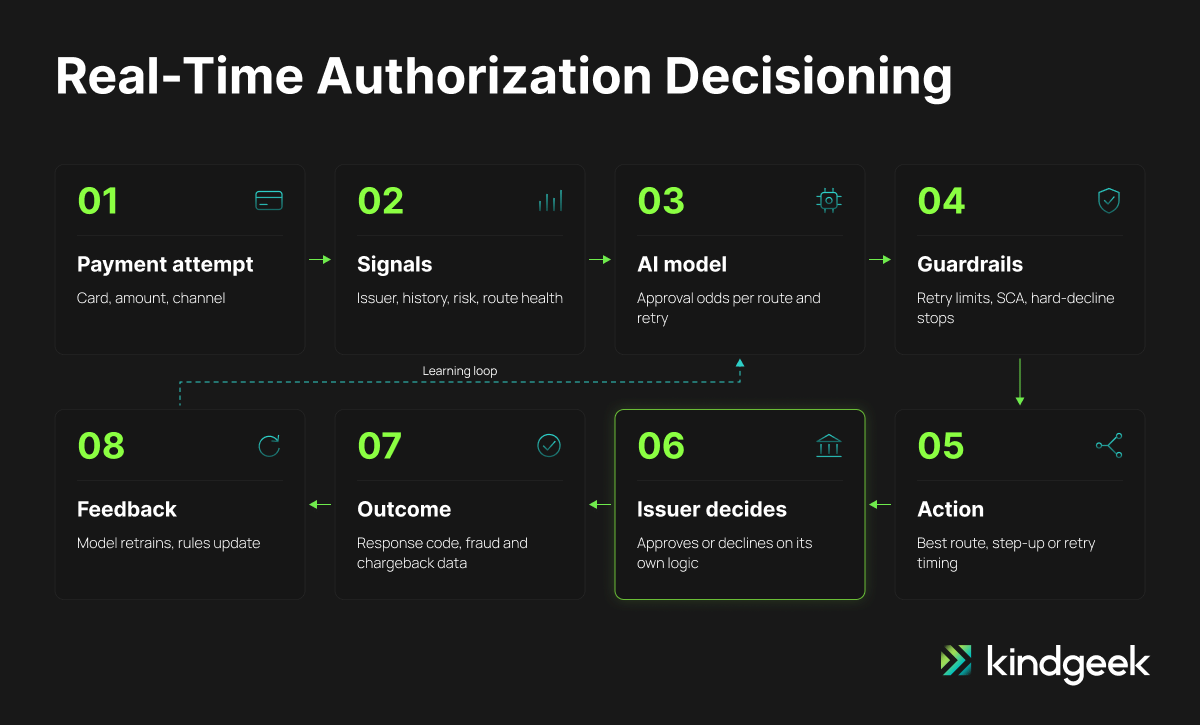
- The gateway captures the attempt and adds device, customer history and issuer data.
- Raw fields become model inputs, such as an issuer’s approval rate over the last hour.
- Models estimate approval odds for each route, authentication path and retry option. They rank them.
- Rules cap what the model may do. For example, halting retries on hard declines and applying SCA where regulation requires it.
- The system routes, authenticates, schedules a retry or stops.
- The issuer approves or declines on its own logic.
- The system stores the outcome, the response code and any later fraud or chargeback data.
- These results retrain the model and update the rules.
AI Models and Optimization Techniques
Model types answer different payment questions.
| Question | Model output | Payment decision it influences |
|---|---|---|
| Will this issuer approve? | Classification: approval probability | Route, retry or step-up |
| Which path is best? | Ranking: ordered list of acquirers and routes | Acquirer selection |
| Does this payment look unusual? | Anomaly and risk score | Fraud threshold, challenge |
| What treatment suits this issuer? | Experiment-driven selection of message and retry variants | Message variant, retry timing |
| How do rules and models combine? | Rules set limits, models rank inside them | Final action |
How AI Reduces False Declines Without Increasing Fraud
A false decline rejects a legitimate payment as risky. High-value customers who hit a decline transact less afterward and sometimes move to a competitor.
AI payment approval optimization works within fraud limits and counts approvals net of the chargebacks they produce. Kindgeek’s real-time transaction scoring service applies behavioral ML to reduce false positives and keep legitimate payments flowing.
Separate Good Customers From Risky Payments
Models score each payment against the customer’s own history. So thresholds can differ by segment, such as returning customers on known devices or first orders of unusual value.
Mastercard presents its Decision Intelligence Pro upgrade as a way to catch more fraud while mitigating false positives.
Step-Up Authentication for Uncertain Payments
A 3DS challenge lets customers authenticate hazardous or odd payments. UK providers can apply the transaction risk analysis exemption if their fraud rates meet standards and real-time inspections uncover no unusual expenditure, device, or location signs.
Payments that don’t qualify require strong customer authentication (SCA).
Use Issuer Signals and Watch Chargebacks
Issuers have limited information when assessing a payment. Stripe’s Enhanced Issuer Network shares Radar fraud scores with issuers including American Express, Capital One and Discover. Stripe reports a 1–2% authorization uplift on eligible volume for large users.
Relaxing fraud checks may increase chargebacks and declines. Compare pre- and post-model acceptance rates, fraud, and chargebacks for the identical transactions. An approval boost may not be worth the risk if chargebacks climb too.
AI for Payment Authorization Across Payment Scenarios
Payment type shapes the decline risk and the lever that fits.
| Scenario | Main decline risk | What AI adds |
|---|---|---|
| One-time e-commerce | Issuers apply more conservative logic online | Fuller request data and digital wallets |
| Subscriptions | Off-session charges, expired cards, soft declines | Credential refresh and timed retries |
| Cross-border | Foreign acquirer, cautious issuer | Routing to local acquiring |
| Multi-PSP | Uneven performance by issuer | Per-issuer route ranking and failover |
| High-value | Tighter issuer and fraud checks | Step-up authentication and tighter thresholds |
Subscriptions carry extra exposure because the customer is absent when a charge fails, so a failure can become involuntary churn.
For cross-border sales, banks are often more likely to approve domestic payments, which is why local acquiring matters.
Kindgeek’s overview of white-label payment gateways explains how the parts of a payments layer fit together.
AI Payment Authorization in the US vs. UK
US: Routing Choice and Authentication Decisions
Where SCA is optional, authentication becomes a commercial choice in the US.
Debit adds a routing dimension. Regulation II requires issuers to enable at least two unaffiliated networks for debit, and a rule effective July 1, 2023 made clear that this covers card-not-present transactions. Merchants or their acquirers can therefore choose between enabled networks, mainly to cut cost. Approval rates can differ by network, so test that effect rather than assume it.
UK: Strong Customer Authentication and 3DS
UK payment service providers must apply SCA under the FCA’s technical standards, with exemptions for eligible payments. Remote payments up to £25 can be exempt, provided spending since the last SCA stays within £85 or, depending on which counter the issuer uses, within five consecutive payments. Recurring payments with the same amount and payee can also be exempt after the first authenticated payment. Merchant-initiated transactions, such as most card subscription charges, fall outside SCA.
Providers using the transaction risk analysis exemption must stop applying it if their fraud rate exceeds the reference rate for two consecutive quarters. AI can assess payment risk in real time, but it cannot override these regulatory limits.
How to Measure and Test AI Authorization Performance
AI authorization rate optimization pays off when net revenue rises along with the rate.
| Metric | What it tells you |
|---|---|
| Authorization rate by segment | Baseline per issuer, country, card type and channel |
| Net approved revenue per attempt | Value kept after refunds and chargebacks |
| False-decline rate | Legitimate payments lost to risk rules |
| Retry recovery rate | Share of soft declines recovered |
| Fraud and chargeback rate | Cost of the approvals you added |
| Authentication completion rate | Where challenges lose customers |
| Cost per approved payment | Scheme, acquirer and retry fees |
| Decision latency | Time added at checkout |
Worldpay puts the global average card authorization rate at 85% to 90%, optimized merchants at 91% to 96%, and its best clients above 97% in select verticals.
Test With a Control Group
A reliable test needs five things:
- A baseline for each segment before changes.
- A holdout group that continues using the existing logic.
- Comparable cohorts with the same issuer, country and transaction amount range.
- Net revenue per attempt alongside approval rates.
- Enough time for fraud and chargebacks to emerge, which can take weeks or months.
Kindgeek applies the same testing principles to production AI models. A/B testing and drift detection are used to track performance after deployment.
Rolling Out Authorization Optimization: Steps and Practical Guidance
Our delivery framework at Kindgeek typically runs a rollout of AI for payment authorization through four stages.
- Week 1-3. Audit the data, map the regulatory restrictions and identify success metrics.
- Weeks 4-8. Create an initial model using real transaction data and test integration points.
- Weeks 8-16.We build a production model with data pipelines, explainability and monitoring.
- From week 16 we deploy, run A/B testing and monitor for model drift.
For fraud models, we often work with 6–12 months of labeled transaction history when available. But the required period depends on transaction volume, seasonality, label quality, and the target use case.
Five practices keep the results measurable:
- Read approval rate next to the fraud and chargeback rate of the same cohort.
- Keep hard declines out of retry queues. Visa charges fees for those retries.
- Set a separate strategy for each issuer and market.
- Combine routing with network tokens, retry logic and authentication tuning.
- Run a holdout test before relying on a vendor’s uplift figure.
Build vs. Buy AI Payment Authorization Technology
Payment authorization optimization AI comes in three shapes.
| Option | Best when | Trade-off |
|---|---|---|
| PSP-native optimization | One main PSP handles the volume | Results are visible while the model internals stay with the PSP, and gains stay inside its network |
| Payment orchestration platform | Several PSPs or acquirers share the volume | Adds a layer to run, though Stripe previewed Orchestration in 2025 to optimize across multiple providers (currently in private preview) |
| Custom model | Large volume, unusual issuer mix or proprietary data | You own the models, the data pipelines and the MLOps |
Try PSP-native optimization if one PSP handles most of your payments. It provides a baseline before adding tools.
Consider an orchestration platform for many PSPs or acquirers handling payments. It centralizes provider routing and retries.
Only build a custom model if a measurable gap remains and income justifies engineering and MLOps expenditures.
When assessing a vendor’s AI features, ask which part of the payment process they optimize and whether the claimed uplift was tested against a control group.
Kindgeek typically takes an AI use case from discovery to production in 3–4 months for a single use case, or 4–6 months when several models work together. Models run as microservices connected to the payment pipeline through APIs. Explore our AI services for fintech and custom fintech software development.
Real-World Examples
These three vendor-reported examples show how AI can improve payment authorization. Their results should be treated as benchmarks to validate.
| Company | Approach | Reported result |
|---|---|---|
| Stripe | Adaptive Acceptance retries declined payments in real time with transformer models | Over $6 billion recovered for businesses in 2024 |
| Mastercard | Decision Intelligence scores transactions for issuers, and Decision Intelligence Pro adds generative AI | 143 billion transactions scored a year (February 2024), with initial modelling showing fraud detection up 20% on average and up to 300% |
| Worldpay | Retries, dynamic routing and credential updates layered for a digital marketplace | 8.1% higher approval rate and 12.7% fewer false declines in 60 days |
What Comes Next for AI Payment Optimization
AI authorization models are moving beyond individual tasks towards systems that assess several payment signals at once. Stripe’s Payments Foundation Model is one example. Trained on tens of billions of transactions, it raised detection of card-testing attacks on large businesses by 64% in early results, according to Stripe’s Sessions 2025 announcement. Stripe says its transformer-based AI also weighs authorization rate, fraud risk and refund likelihood when deciding how to process each payment.
The other challenge is around agent-initiated payments. Issuers and merchants need to be able to identify when an AI agent is making a purchase on behalf of a customer. Mastercard’s Agent Pay addresses this with Agentic Tokens. Its Agent Pay Acceptance Framework registers and verifies AI agents before they can transact.
Looking for AI that lifts approvals while holding fraud steady?
We respond within 24 hours to an AI discovery request with an initial assessment of feasibility and data readiness, plus recommended next steps
Contact usHow does AI improve payment approval rates?
AI optimizes payment routing, transaction data, credentials, authentication, and retry scheduling to boost approval rates. Each method can recover various denied payments.
What is a good payment authorization rate?
Worldpay estimates global card authorization at 85–90% vs. 91–96% for optimized businesses. However, a good rate depends on the payment channel, geography and billing model.
Can AI decide whether a payment is approved?
No. Only the issuing bank approves. AI can improve routing, data, credentials, and authentication for merchant-side payment requests, but not issuer decisions.
Which payment declines can AI recover?
AI can help recover soft declines, outdated credentials, missing authentication and some technical failures. Hard declines generally cannot be recovered through retries. Visa restricts retries for certain decline codes and charges fees for violations. Mastercard also charges fees for excessive retries.
How do you measure AI authorization optimization?
Test the new model against a control group with the same issuer, country, and card type. Track authorization rates, fraud, and chargebacks against net approved revenue per attempt. This indicates if greater approval rates improve profits.