


Recently updated on September 28, 2026
Payments fraud is a constant wherever money moves. Payments fraud reached 76% of US organisations in 2025, and only 17% of them use AI against it. Both figures come from the 2026 AFP Payments Fraud and Control Survey, which polled 465 treasury practitioners in January 2026.
Those two figures describe the same problem from opposite ends. Fraud reaches three-quarters of organisations, and most of the decisions meant to stop it still come from thresholds written by hand.
AI in payment fraud detection and prevention changes the picture. A model scores each transaction against millions of past ones and returns a probability, which a policy layer converts into an approve, a decline or a challenge.
This guide covers the signals those models read, the architecture that serves them inside an authorisation window, how a score becomes a decision, and the metrics that show whether any of it is working.
- 01What Is AI Payment Fraud Detection?
- 02Why Static Rules No Longer Hold the Line
- 03What Types of Payment Fraud Can AI Detect?
- 04The Signals That Make a Fraud Model Work
- 05Machine Learning Models Used for Payment Fraud Detection
- 06Rules, Models, or Both?
- 07Real-Time AI Fraud Detection Architecture
- 08How Real-Time Fraud Decisioning Works
- 09Cutting Fraud Without Raising False Declines
- 10Graph AI and Coordinated Fraud Networks
- 11Generative AI and AI Agents in Fraud Operations
- 12Training, Drift and Model Monitoring
- 13How to Measure AI Fraud Detection Performance
- 14Security, Privacy and Compliance
- 15AI Fraud Detection in Payment Networks
- 16How to Implement AI Fraud Detection in an Existing Payment System
- 17Build, Buy or Hybrid?
- 18AI in Payment Fraud Detection Trends 2026 and Beyond
- 19Build Real-Time AI Fraud Detection Into Your Payment Platform
- 20FAQ
What Is AI Payment Fraud Detection?
AI payment fraud detection uses machine-learning models to estimate the probability that a payment is fraudulent, in the milliseconds before authorisation completes. The model returns a score and a set of reason codes. A policy layer turns that score into an approve, a decline, a step-up challenge or a review queue.
Keeping those two steps apart carries the whole design. The model produces a number, and deterministic policy code decides what happens to the money. Months later, when a regulator or a customer asks why you blocked a payment, the decision is still reconstructable.
Where AI Sits in the Transaction Lifecycle
AI for payments fraud detection touches four points in the flow. With only the second in place, accuracy erodes as fraud patterns move:
- Pre-authorisation: you score device, session, identity and login signals at checkout or onboarding, before a payment request exists.
- Authorisation: the model returns a transaction risk score inside the issuer or scheme timeout window, on a budget of tens of milliseconds.
- Post-authorisation: batch scoring of settled transactions, merchant portfolios, beneficiary networks and linked accounts.
- Feedback: you return confirmed fraud, chargebacks and review outcomes to training alongside the decision they relate to.
Step two gets the attention. Step four is what keeps steps one to three accurate.
AI Fraud Detection vs. Rule-Based Fraud Detection
| Rule-based detection | AI fraud detection | |
|---|---|---|
| Decision logic | Hand-written thresholds | Learns from labelled outcomes |
| Output | Block or allow | A probability plus reason codes |
| New attack pattern | Waits for a rule release | Picked up at the next retraining |
| Strength | Deterministic, instantly auditable, fast to change | Precision across hundreds of weak signals |
| Typical failure | Stale thresholds, rising false declines | Drift; opacity without explainability work |
| Ongoing commitment | Change control | Drift monitoring, retraining, challenger models |
Rules still carry the controls that need a fixed answer. Models cover the ground between them.
Why Static Rules No Longer Hold the Line
Attacks Adapt Faster Than Release Cycles
A rule records one hypothesis about fraud at one moment in time. Attackers probe your live controls and adapt within days, while a rule change moves through review, testing and deployment.
That gap between attacker speed and release speed shows up most sharply in enumeration. Bots guess card numbers, expiry dates and security codes at scale, and Visa puts the cost of those attacks at around $1.1 billion a year. The attempts rotate across BINs, merchants and infrastructure faster than any static list can track.
The Fraud Mix Has Moved to Payments the Customer Authorises
In the EEA, total payment fraud rose to €4.2 billion in 2024 from €3.5 billion in 2023, according to the joint EBA–ECB report published in December 2025, which puts fraudulent credit transfers at €2.5 billion, up 24%, and names manipulation of the payer as the growth area.
The 2025 figures point the same way. Across UK banks, unauthorised fraud losses fell 5% to £703.4 million while APP losses rose 19% to £576.4 million, according to UK Finance’s Annual Fraud Report published in June 2026.
Strong customer authentication verifies that the legitimate account holder authorised the payment. In an APP scam the account holder does authorise it, so the check returns a pass. Detection rests instead on behavioural signals: beneficiary history, session tempo, and how far the payment sits from the payer’s own pattern.
False Declines Cost More Than the Fraud They Stop
A fraud report counts the fraud stopped. Measuring the good customers turned away takes a second number, and that number decides whether the first one is worth having. Stripe put a number on its own share of it: its acceptance models recovered a record $6 billion in falsely declined transactions in 2024, a 60% year-on-year rise in retry success rate.
An acceptance target alongside the fraud target keeps both numbers under the same review.
Real-Time Rails Removed the Safety Margin
Instant payment schemes settle in seconds and are irrevocable. The overnight batch that once caught and reversed suspicious payments has gone with them. The entire decision now completes inside the authorisation window, which sets a hard ceiling on how complex a model can be.
What Types of Payment Fraud Can AI Detect?
Card fraud carries the largest share by volume: $33.41 billion worldwide in 2024, with the Nilson Report projecting $41.06 billion by 2030. That total breaks into seven typologies, each leaving its own trace in the data.
| Fraud type | What it looks like | Signals that catch it |
|---|---|---|
| Card-not-present fraud | Stolen credentials used at online checkout | Device and IP reputation, billing–shipping mismatch, velocity against the cardholder’s own history |
| Account takeover | Credential stuffing or SIM swap, then a payout | Login anomalies, new device, behavioural biometrics, beneficiary added minutes before |
| Enumeration and card testing | Bots guessing card number, expiry and CVV at scale | Request tempo, decline-code patterns across BIN ranges, shared infrastructure between attempts |
| Synthetic identity | A fabricated identity nurtured into a real credit line | Thin-file history, attributes shared across accounts, graph links to known-bad clusters |
| APP scams and business email compromise | The victim authorises the payment themselves | Beneficiary risk, payee-name mismatch, session pressure signals, deviation from payment history |
| First-party and merchant fraud | Chargeback abuse, collusive or compromised merchants | Dispute ratios by reason code, refund patterns, merchant portfolio history |
| Coordinated fraud rings | Many accounts, one operator | Shared devices, addresses and beneficiaries; community detection on the entity graph |
Business email compromise cuts across several of these rows. The 2026 AFP survey put it at 74% of US organisations in 2025, up from 63% a year earlier, against AI adoption of 17%, which leaves AI and ML in B2B payment fraud detection uncommon. These payments are legitimate in form and correctly authorised, so intent carries the only signal. A behavioural model reads it.
The Signals That Make a Fraud Model Work
You win accuracy in the feature layer. Six signal families carry most of the weight in an AI fraud detection payments stack:
- Transaction and velocity features: amount, currency, merchant category, and spend rate against the account’s own baseline instead of a portfolio average.
- Device and session intelligence: device fingerprint, IP reputation, emulator and automation detection, typing and navigation tempo.
- Behavioural history: where this customer normally shops, at what hours, in which currencies; and how this merchant’s dispute profile compares to its category.
- Identity and authentication signals: KYC verification outcomes, 3-D Secure results, SCA exemptions applied, step-up history and outcomes.
- Relationship and graph data: shared devices, cards, addresses and beneficiaries linking accounts that look unrelated at transaction level.
- External threat intelligence: scheme-level compromise alerts, breached credential feeds, mule account reports and sanctions data.
At Kindgeek we scope the feature layer first, because the same computation has to run identically in training and at serving time. A 30-millisecond window bounds what the feature set can include. That layer also feeds the wider AI in payment processing stack, which draws on the same records.
Machine Learning Models Used for Payment Fraud Detection
AI/machine learning in payment fraud detection usually runs as a small portfolio of models, each covering ground the others miss.
| Model family | What it does | Where it fits |
|---|---|---|
| Gradient-boosted trees (XGBoost, LightGBM) | Supervised scoring over tabular features | The primary scorer in the authorisation path |
| Logistic regression | Transparent, fully explainable baseline | Regulated segments, challengers, sanity checks |
| Unsupervised anomaly detection (isolation forests, autoencoders) | Flags behaviour with no label yet | Enumeration, novel attack types, cold start |
| Sequence and transformer models | Reads order and timing across events | Session behaviour, acceptance and retry prediction |
| Graph features and graph neural networks | Learns from relationships between entities | Fraud rings, mule networks, synthetic identity |
| Ensembles | Combines scores under one calibration | The production default in most portfolios |
Latency constrains architecture choice more tightly than benchmark scores do. Stripe shows what becomes possible once that constraint lifts: its move from gradient-boosted trees to a TabTransformer-based network delivered 70% greater precision on falsely declined transactions while attempting 35% fewer retries. That model runs after the decline, outside the authorisation window, which is what makes the heavier architecture affordable.
Anything scoring in flight gets trimmed to fit the window. Fraud scoring is one of several models sharing that data layer, alongside the wider set of machine learning use cases in banking.
Rules, Models, or Both?
Every production fraud system we see at Kindgeek runs all three layers. The useful question is how they divide the work.
- Rules still win where the answer is binary by nature: sanctions hits, scheme mandates, velocity caps, and any control an auditor needs to point at directly.
- Models win where the signal is distributed: hundreds of weak indicators, each too small to write a rule around, and populations where the right threshold differs per customer.
- Policy overrides sit above both: kill switches, forced reviews for specific segments, and thresholds that a risk owner can move without a model release.
The hybrid pattern is what makes a model deployable in the first place, because the policy layer is where the guarantees live.
Real-Time AI Fraud Detection Architecture
Everything a payment fraud detection AI system does in production runs through seven stages, and the model occupies exactly one of them.
- Event ingestion: the authorisation request, plus device, session and customer context, arrives on a stream with a stable transaction identifier.
- Real-time feature generation: velocity counters, aggregates and graph lookups that run on the same code path as training, backed by a feature store or a shared feature library.
- Model inference: one or more scorers return probabilities and reason codes, usually inside a 10–50 ms budget.
- Rules and policy engine: the engine applies mandatory controls, overrides and segment-specific thresholds to the score.
- Decision engine: the score plus policy resolves to approve, decline, challenge or review.
- Action and customer experience: step-up authentication, soft decline with retry, hard decline, or silent release into a review queue.
- Outcome feedback: you write chargebacks, confirmed fraud, review verdicts and step-up results back against the original decision.
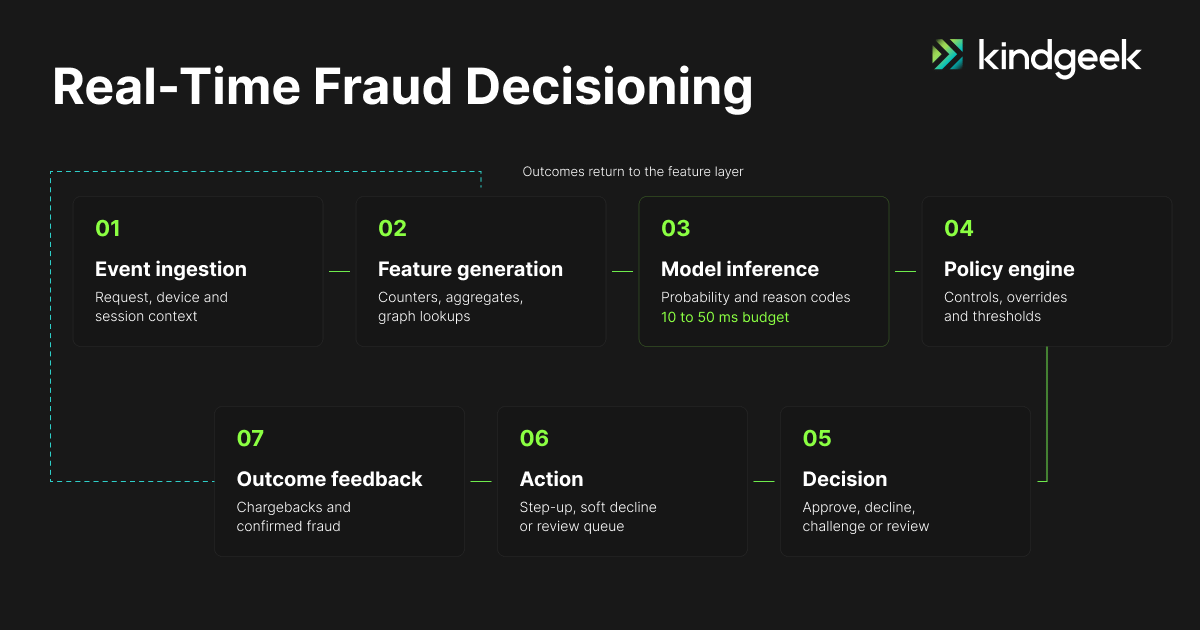
Two components decide whether the architecture holds together: a feature layer computing identical values in training and at serving time, and a policy layer specified alongside the model. The feedback loop at stage seven closes the system.
How Real-Time Fraud Decisioning Works
The threshold map above the score decides much of the commercial outcome.
- Approve below the lower threshold, which covers the overwhelming majority of traffic.
- Step up in the ambiguous band with 3-D Secure, biometric confirmation or an in-app prompt, which converts an uncertain decline into a recoverable payment.
- Review where value or exposure justifies an analyst, with reason codes and graph context already in front of them.
- Decline above the upper threshold, recording a reason code and leaving an appeal path open.
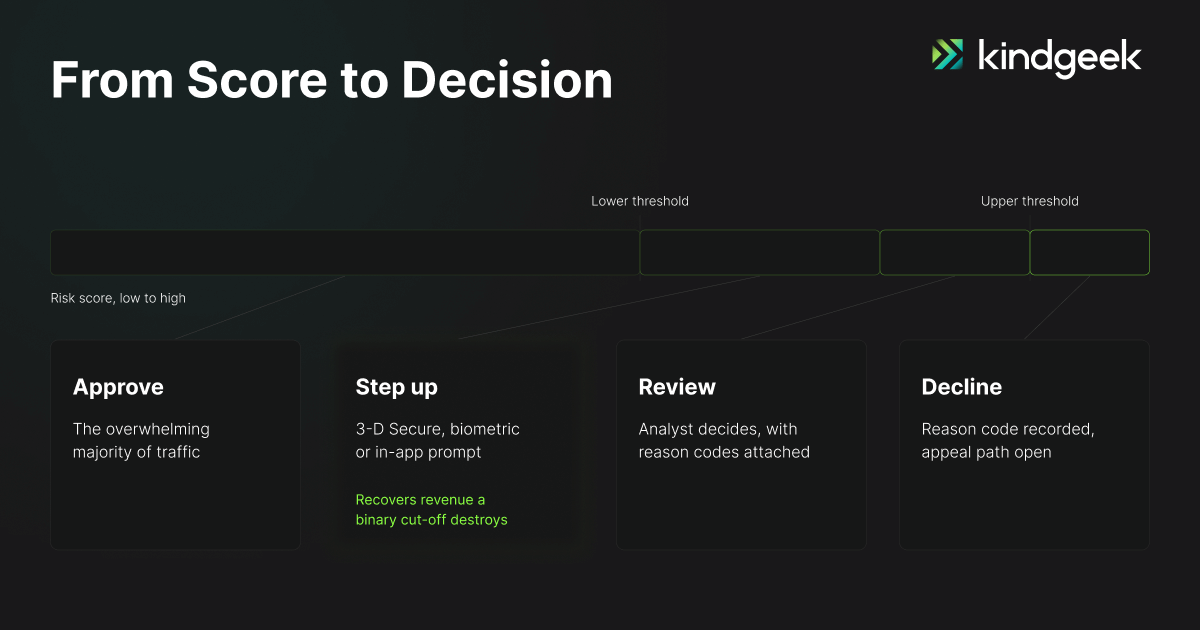
At Kindgeek, we set thresholds per segment. A first-time buyer on a new device and a five-year customer on a known handset warrant different cut-offs, and one global threshold averages across both. Decision latency belongs on the same dashboard as accuracy, where the p99 figure decides which model can go live.
Cutting Fraud Without Raising False Declines
In a Mastercard and FT Longitude survey of payments executives published in February 2026, 83% said AI had significantly reduced false positives and customer churn over the previous year. Among the AI in payment fraud detection benefits 2026 has put on record, this one carries the clearest P&L line.
Four mechanisms do the work:
- Customer-level baselines instead of portfolio averages, so you measure unusual against this customer’s own history.
- Dynamic thresholds that move with segment, channel and current attack pressure.
- Step-up authentication in place of hard declines across the ambiguous band, which recovers revenue that a binary cut-off destroys.
- An explicit cost model: fraud loss per basis point on one side, lost margin plus customer lifetime value on the other. With both numbers priced, thresholds move in either direction as the evidence changes.
The advantages of AI in fraud detection for payment systems land in two numbers we track: detection at a fixed decline rate, and the size of the review queue.
Graph AI and Coordinated Fraud Networks
Transaction-level scoring has a structural blind spot. Each payment in a mule network or a bust-out ring can look ordinary on its own; the pattern only exists in the relationships between accounts, devices, merchants and payment instruments.
The BIS Innovation Hub tested this directly in Project Aurora, applying machine learning and network analysis to synthetic cross-border payments data. Graph-based models outperformed the siloed, rules-based approach in every monitoring scenario, from single-institution to cross-border.
There are two levels of commitment here. Graph features such as shared-device counts, distance to a known-bad node and beneficiary reuse can run offline and feed an existing model as ordinary inputs, which is the pragmatic starting point.
Graph neural networks learn on the structure itself and detect more, at the cost of a serving path that resolves relationships inside the authorisation window. At Kindgeek we usually start with the features and earn the GNN.
Generative AI and AI Agents in Fraud Operations
Generative AI earns its place in the operations layer around the model. The latency budget and the reproducibility requirement both rule it out of an authorisation decision.
- Case summarisation: turning months of transaction and contact history into an investigation-ready brief.
- Alert triage: drafting the initial assessment and evidence pack, so analysts open each case with the groundwork done.
- Knowledge retrieval: surfacing the relevant typology, scheme rule or past case in seconds.
Live decisions on a customer’s money stay with the scoring model and the policy engine. Our guide to generative AI in fintech maps where that line falls across the wider stack.
Training, Drift and Model Monitoring
Fraud models decay faster than most models in financial services, because the population you are modelling reacts to the model.
- Labels: six to twelve months of event-level history with confirmed fraud and chargeback outcomes is a realistic starting point. Chargeback labels arrive weeks late, so the training set is always slightly behind reality.
- Class imbalance: fraud is a fraction of a percent of traffic, so overall accuracy sits above 99% whatever the model does. Precision, recall and cost-weighted evaluation carry the signal.
- Data leakage: any feature computed after the decision point contaminates the result. Time-ordered splits and strict point-in-time feature joins are the only defence.
- Backtesting: across a full seasonality cycle, with per-segment reporting.
- Shadow mode and champion–challenger: score live production traffic while the incumbent system keeps deciding, then compare. Running it for a full cycle is what separates a promising offline result from a defensible production decision.
- Drift monitoring: score distribution, feature drift, approval and decline rates by segment, and precision against confirmed outcomes.
How to Measure AI Fraud Detection Performance
Eight numbers, recorded before the model goes live, can tell you whether it works:
- Fraud detection rate: share of confirmed fraud value caught before settlement.
- Precision and recall: per segment, because segment-level precision is what you act on.
- False-positive rate: legitimate transactions your system flags, which you estimate through holdout traffic or post-decline recovery analysis.
- False-decline rate: the revenue-side twin of the fraud number, reported beside it.
- Fraud loss rate: fraud value in basis points of processed volume.
- Chargeback rate: by reason code, against scheme thresholds.
- Manual review rate: queue volume and cost per case, since routing 4% of traffic to analysts moves detection into manual work.
- Decision latency at p99: the constraint that decides how complex a model you can actually deploy.
A rules-only control group running through the rollout can turn a before-and-after comparison into an attributable result.
Security, Privacy and Compliance
Four regimes apply to a payment fraud model:
- PCI DSS: scopes the cardholder data environment the model reads from. The current standard is v4.0.1, and the 51 previously future-dated requirements became mandatory on 31 March 2025. A hosted inference endpoint can pull a third party inside that boundary.
- GDPR: governs automated decision-making affecting individuals, which puts a right to explanation and a human review path around consequential declines. Reason codes become a compliance artefact.
- EU AI Act: purpose decides classification. Annex III point 5(b) classifies AI that evaluates the creditworthiness of natural persons as high-risk and expressly excludes AI used to detect financial fraud. A pure fraud scorer sits outside that clause; add affordability or credit-limit logic to the same model and it comes back in.
- DORA: puts third-party model dependencies and their resilience squarely in scope for EU financial entities.
Vendor risk deserves its own line. When a provider owns both the model and the outcome data, you lose the option to retrain elsewhere at the end of the contract. Labels kept on your own side preserve that option.
All four regimes point the same way. Explainability and audit trails belong in the architecture from the first design, which is how we scope Kindgeek’s AI work for financial services.
AI Fraud Detection in Payment Networks: Visa, Mastercard and Stripe
All three score transactions with machine learning inside or immediately around the authorisation path, and each publishes what that scoring returns.
| Company | What the system does | Published result |
| Visa | Real-time scoring across VisaNet, including the VAAI Score, which uses generative AI components to score enumeration attacks on card-not-present traffic | FY2025: ecommerce fraud rates across the Visa ecosystem down 8%, with nearly twice as many fraudulent ecommerce transactions blocked as the prior year |
| Mastercard | Decision Intelligence Pro scores transactions at network level for issuer banks | At launch in February 2024, initial modelling showed fraud detection rates up 20% on average and as much as 300% in some cases, with the score returned in under 50 ms |
| Stripe | Adaptive Acceptance identifies and retries falsely declined transactions before the customer sees a decline | $6 billion recovered in 2024, a 60% year-on-year rise in retry success rate, at 70% greater precision with 35% fewer retry attempts (latest figure Stripe has published) |
Sources: Visa, Mastercard, Stripe.
Both card networks feed their scores back into issuer models, so a bank buying either gets detection trained on traffic far beyond its own portfolio. That is the practical argument for network-level AI fraud detection in payment networks: the training data reaches well past any one issuer’s portfolio.
How to Implement AI Fraud Detection in an Existing Payment System
The sequence we run starts with one measurable problem and ends with automated decisioning on full traffic.
- Problem definition and baselines: the eight metrics above, on record while the incumbent system still runs alone.
- Data mapping: event-level transaction records with stable identifiers across ledger, switch and acquirer feeds, plus device, session and outcome data. In the projects Kindgeek runs, this is usually the long pole.
- Offline evaluation: time-ordered splits across a full seasonality cycle, with per-segment reporting.
- Shadow mode: the model scores live traffic without acting on it, and we compare the counterfactual against the current system.
- Coexistence with existing rules: the model runs as an additional signal inside the current policy engine before it replaces anything.
- Step-up and review workflows: so the ambiguous band routes to a challenge or a review queue.
- Gradual rollout: 5% of traffic, then 25%, then full volume, with a rules-only fallback available throughout.
- Monitoring and retraining: drift dashboards, retraining cadence and threshold reviews as standing operations.
Four pieces of work set the timeline: consolidating payment data held across legacy systems, covering cold start after a processor migration while the incumbent’s model keeps its years of learned behaviour, exposing the event records behind a core that reports daily summaries, and fitting the model to the latency limits of the authorisation window.
Kindgeek scopes integration and data work before modelling in fintech software development projects for exactly this reason.
Build, Buy or Hybrid?
How proprietary is your transaction data, and how much of the final decision do you want to own? High on both, build. Low on both, take the processor’s tooling and put your engineering into the data layer feeding it.
| Approach | Fits when | What it costs you |
|---|---|---|
| Processor or PSP fraud tooling | Standard card flows, one or two acquirers, speed to launch matters most | Outcome data held on your side, so labels stay with you if the provider changes |
| Specialist fraud platform | Typology coverage and network intelligence beyond what you would build in-house | Integration into your policy engine, and vendor concentration risk under DORA |
| Custom models | Proprietary data, an unusual risk profile, or volume where a one-point lift outweighs the cost of running the model | MLOps capacity, retraining cadence and model documentation for the life of the system |
| Hybrid decisioning | A vendor score exists and proprietary signals sit alongside it | One policy engine owning the final decision and one place where reason codes originate |
For most PSPs, acquirers and EMIs we work with at Kindgeek, hybrid is the answer. Take the network or PSP score as a feature, add your proprietary signals next to it, and hold the final decision logic in a layer you control, which is where it sits in the core payment platform we deploy for clients.
AI in Payment Fraud Detection Trends 2026 and Beyond
Four shifts are already visible in production stacks. They set the direction for AI/ML in real-time payment fraud detection trends over the next two years.
- From transaction scoring to identity and intent: the question moves from whether the transaction looks anomalous to whether the customer intends the payment, the framing that authorised push payment scams demand.
- Continuous behavioural authentication: scoring risk across the whole session instead of at a single checkpoint, so the step-up fires when behaviour changes.
- Real-time graph: relationship features served inside the authorisation window instead of computed overnight, which is where the hard engineering sits.
- Agentic payments: software initiating payments under authority granted in advance. Retraining teaches the model to read delegation as a signal, which is what keeps agent-initiated payments flowing.
Governance is becoming permanent alongside all of it: model inventories, drift dashboards and decision-level audit trails as standing platform components. For the wider industry picture, including agentic commerce, see Kindgeek’s guide to AI in payments.
Build Real-Time AI Fraud Detection Into Your Payment Platform
If you run regulated card or account-to-account volume, Kindgeek can build it with you: a feature layer that computes identical values in training and production, a policy engine that owns the final call, and shadow-mode evaluation against your own traffic before any model takes a decision. PCI DSS, DORA and EU AI Act requirements go into the architecture ahead of your first audit.
Building AI for payments fraud detection into a live platform?
Share your current fraud loss rate and false-decline rate. We will come back with what a model could move on your own traffic, and what building it would take.
Contact usHow does AI detect payment fraud?
A model reads the transaction, the device and session, the customer’s own spending history and the relationships between accounts, then returns a probability that the payment is fraudulent. It calculates that score in milliseconds, before authorisation completes. A policy engine converts the score into an approve, decline, step-up or review, applying your mandatory rules and segment thresholds on top. Confirmed fraud and chargeback outcomes flow back into training so the model keeps pace with new patterns.
Is AI better than rules for fraud detection?
They solve different problems. Rules are deterministic, instantly auditable and correct for controls where the answer is binary by nature, such as sanctions screening or contractual velocity caps. Models are better where the signal is spread across hundreds of weak indicators and where the right threshold differs per customer. Every production system Kindgeek builds runs both, with the policy layer owning the final decision.
What data do you need to train a payment fraud detection model?
Event-level transaction records rather than daily summaries, with identifiers that stay stable across the ledger, switch and acquirer feeds. For machine learning payment fraud detection, six to twelve months of history with confirmed fraud and chargeback labels is a realistic baseline. Device and session signals, identity and authentication outcomes, and relationship data between cards, accounts and beneficiaries add most of the remaining accuracy. Outcome labels returning continuously are what hold that accuracy in place after launch.
How can AI reduce false declines?
By scoring each customer against their own baseline, and by routing the ambiguous band to a step-up challenge rather than a hard decline. Dynamic thresholds that move with segment and channel recover traffic that a single global cut-off destroys. The other half of the answer is measurement: report false-decline rate next to fraud basis points, so the cost is visible when thresholds come up for review.
Can generative AI detect payment fraud?
Not in the scoring path. The authorisation window runs to tens of milliseconds and demands the same output for the same input, which rules out large language models. Where generative AI earns its place is in fraud operations: summarising cases, drafting investigation notes, triaging alert queues and retrieving relevant typologies. Visa’s VAAI Score is the nuance here: it uses generative AI components in model construction for enumeration detection, with the live decision still made by the scoring model.