


DevSecOps implementation means making security part of how your teams plan, build and release software, with named owners, automated checks and agreed rules for what may stop a release. The most reliable way to get there is to start with one pilot team, prove the change against a measured baseline, and then roll the same templates and policies out to other teams.
Most programmes stall for the opposite reason. A company buys scanners, wires them into CI/CD and gets thousands of findings that nobody owns. Releases slow down, developers learn to click past warnings, and the actual risk barely moves.
This DevSecOps implementation guide walks through that sequence, including where the advice stops working.
Key Takeaways
- DevSecOps implementation is an organisational change that combines people, processes, governance and automation so that security becomes part of everyday delivery.
- A readiness assessment and a measured baseline come before new tooling.
- Security teams set policy, platform engineers build guardrails, and developers fix what they ship.
- Only a short list of high-confidence findings should block a release.
- Security and delivery metrics are reported together, so neither hides a drop in the other.
What Changes When You Implement DevSecOps
The biggest change is who owns a security finding and when it appears. Traditional DevOps reviews security late, through a separate team. Adding scanners to the CI/CD pipeline (the automated build, test and deploy chain) moves findings earlier but often leaves nobody responsible for them.
| Traditional DevOps | DevOps plus security tools in CI/CD | DevSecOps operating model | |
| Who owns a finding | Central security team | Unclear, often nobody | The team that owns the code |
| What blocks a release | A manual sign-off | Whatever the scanner flags, or nothing | An agreed policy per application tier |
| How audit evidence is produced | By hand before an audit | Scattered across tool dashboards | By the pipeline on every change |
| What gets measured | Open findings | Number of scans and tools | Risk reduction and delivery speed together |
The third column is the target. Most teams start between the first two.
Before You Start: Assess Your DevSecOps Readiness
The first real step of the DevSecOps implementation process is an honest picture of where you are: current state, gaps, priorities and a measurable baseline.
Inventory Applications, Repositories and Delivery Pipelines
List every application, its repositories, the pipeline that ships it and its owner. Expect to find forgotten services and pipelines nobody maintains.
Map Existing Security Controls
Record which checks already run, who reads the results and whether anything ever blocks a release.
Identify High-Risk Applications and Data
Rank applications by the data they handle (payments, personal data, credentials), by internet exposure and by regulatory scope. This ranking becomes the application tiers used for policies in Step 6.
Assess Current DevSecOps Maturity
A structured framework such as OWASP SAMM keeps the assessment consistent across teams. Use it to find weak areas, not to chase a score.
Identify Gaps in People, Processes and Tooling
From our projects: in a remediation programme we estimated this year for a European consumer platform, the main application had no CI/CD pipeline, almost no automated tests, secrets in configuration files and production access tied to specific people. So secrets and access came first, a gated pipeline next and refactoring last.
Establish a Baseline for Security and Delivery Metrics
Measure before you change anything, using the security and delivery metrics listed in Step 10.
An illustrative output looks like this:
| Area | Current state | Gap | Priority |
| Secrets | Credentials in config files | No secret manager or detection | High |
| Ownership | Findings go to one security engineer | No owner per repository | High |
| Evidence | Collected by hand before audits | No traceability from change to deployment | Medium |
If your team lacks the time or the outside view for this, an independent software audit can produce the same baseline.
Step 1. Define DevSecOps Goals and Success Criteria
Each goal should connect a business risk to a number you can track: fewer critical findings reaching production, faster remediation, fewer manual reviews and lead time held flat. Without that link, the programme ends up judged by how many tools were installed. Step 10 lists the full metric set.
Here MTTR means mean time to remediate a vulnerability. The DORA research programme renamed its own MTTR metric to failed deployment recovery time in 2023, so define the term in your reporting.
Step 2. Define Roles and Security Ownership
Ownership is where most programmes are weakest. The split below works for most mid-size engineering organisations:
| Activity | Leads | Supports |
| Threat modelling for new features | Developers and security champion | Security team |
| Fixing findings in owned code | Developers | Security champion |
| Pipeline templates and scanner set-up | Platform or DevOps team | Security team |
| Security policies and gate rules | Security team | Platform team, engineering leads |
| Approving exceptions | Security team with the application’s engineering lead | Compliance, where relevant |
| Audit evidence | Platform team, through automation | Security and compliance |
Security Champions
A security champion is a developer in a product team who spends part of their time on security, translating policy into practice and triaging findings before they reach the central team.
Central Governance vs. Distributed Ownership
A central team owns policies, tooling and exception approval, and product teams own the fixes. In regulated software, exception approval stays central because auditors will ask who accepted each risk.
Step 3. Start With a DevSecOps Pilot
A pilot proves the model on one team before it becomes a mandate. Pick an actively developed, medium-criticality application with a modern pipeline and a willing team lead.
Avoid the most complex legacy system, because its noise will dominate the results and they will not transfer to other teams.
Keep the scope narrow: one application, three or four controls, a fixed period and before-and-after metrics. Record what worked and what developers ignored, because that record becomes the scaling template.
From our projects: on a regulated consumer finance platform, Kindgeek engineers first built the foundations: infrastructure as code (servers and networks defined in version-controlled files), an encrypted store for secrets and separate management and development networks. Only then did they add static code analysis for one core application, about eight weeks in. That set-up became the template for later services.
Step 4. Integrate Security Into Developer Workflows
Security feedback works when it arrives in the tools developers already use, while the change is still fresh in their minds.
- Features that touch money, identity or personal data start with a short threat-modelling session, a structured conversation about what could go wrong and how the design prevents it.
- Findings appear as comments on the exact line of code in the IDE or pull request, not in a separate dashboard.
- Pre-commit hooks for secrets and dependency checks catch the cheapest problems before code leaves the laptop.
- Remediation tickets go into the normal sprint with reserved capacity, so security work never depends on goodwill.
Step 5. Automate High-Value Security Controls
Automate the controls with the best signal-to-noise ratio first and expand later. Our view on the starting order, based on what tends to produce the least noise:
| Control | What it catches | Where it runs | Starting mode |
| Secret scanning | Passwords, keys and tokens committed to code | Pre-commit and CI | Block |
| SCA (software composition analysis) | Known vulnerabilities in open-source dependencies | Pull request and CI | Warn, then block critical exploitable issues |
| SAST (static application security testing) | Insecure patterns in your own source code | Pull request | Warn on new code |
| IaC scanning | Misconfigured cloud resources defined in code | Pull request | Warn, then block critical issues on high-risk apps |
| Container image scanning | Vulnerable packages inside build images | Build | Warn |
| DAST (dynamic application security testing) | Weaknesses visible in a running application | Test environment, scheduled | Report only |
Keep pull request checks fast and schedule heavy scans. On the white-label banking platform, we moved to weekly releases; each automated gate added minutes to a build and removed days of manual regression testing. Tuned security controls follow the same economics. On legacy code, apply SAST gates to new and changed code only, because a first scan can return thousands of findings.
Step 6. Define Security Policies and Risk-Based Gates
Not every finding should block a release. Gates should stop high-confidence, high-impact problems that the developer can fix now and route everything else into a tracked backlog.
| Application tier | Blocks the release | Warns, with a fix deadline |
| Tier 1: payments, personal data, internet-facing | Leaked secrets; critical vulnerabilities with a known exploit; critical infrastructure misconfigurations | High-severity findings |
| Tier 2: internal business systems | Leaked secrets; critical vulnerabilities with a known exploit | Critical and high-severity findings |
| Tier 3: internal tools and prototypes | Leaked secrets | Everything else, reported |
Write these rules as policy as code: machine-readable rules stored in version control and enforced by the pipeline, using an engine such as Open Policy Agent or your platform’s built-in rule sets. Policy changes then get reviewed like any other code change.
From our projects: on the same Kindgeek-built banking platform, a pull request cannot merge if unit-test coverage drops below 80%. The team chose 80% over 100% because a total target invites trivial tests. It is a quality gate, but the lesson carries over to security: a threshold should change behaviour without inviting workarounds.
Every gate needs an exception route with an owner, a reason, any compensating control and an expiry date, approved by the security team. When the exception expires, the gate applies again.
The limitation: switching to block mode before the rules are tuned teaches developers to bypass the pipeline. Run new rules in warn mode until false positives are rare.
Send us your current pipeline set-up and application tiers. Kindgeek’s DevOps engineers will draft gate rules and an exception process that fit your release flow.
Ask our DevOps engineers →Step 7. Build Governance and Continuous Compliance Into DevSecOps
In regulated software, the pipeline should produce audit evidence as a by-product of normal work. In the EU, the Digital Operational Resilience Act has applied to financial entities since 17 January 2025, and its ICT risk and testing requirements flow down to their technology providers through contracts. This is the regulation, not the DORA research programme mentioned in Step 1. Card-data environments answer to PCI DSS on top of that.
Four practices cover most audit questions:
- Compliance checks run in the pipeline against the same version-controlled policies as the gates.
- Every build stores its evidence (scan results, approvals, test reports) linked to its commit.
- Nobody approves their own merge, and production access belongs to roles rather than individuals.
- Traceability runs from ticket to commit, build, artefact, and deployment, including any gate override.
From our projects: on the regulated consumer finance platform described in Step 3, the Kindgeek team built each service image once and promoted it between environments by retagging, so the artefact that passed testing was the artefact that reached production. Automated test results were linked to the test-management tool, which gave auditors a trail without manual collection.
Step 8. Prioritise Vulnerabilities Instead of Creating Alert Fatigue
A severity score alone is not a priority. Veracode reports that more than half of applications carry high or critical flaws, yet only 8.4% are highly exploitable.
Rank findings by exploitability, reachability, exposure and data sensitivity:
- FIRST EPSS scores how likely a vulnerability is to be exploited, and the CISA KEV catalogue lists vulnerabilities already exploited in the wild.
- Reachability shows whether your code actually calls the vulnerable function.
- Exposure shows whether the component can be reached from the internet.
- Data sensitivity reflects what the application handles, such as payments or personal data.
Then set remediation deadlines. The example below is a starting policy, not an industry standard. Its 30-day limit for critical issues matches the one month PCI DSS allows for critical patches.
| Finding | Tier 1 deadline | Tier 2–3 deadline |
| Critical, known to be exploited | 7 days | 14 days |
| Critical | 30 days | 30 days |
| High | 60 days | 90 days |
| Medium and low | Next planned work | Next planned work |
Route findings to their owners automatically, for example through a CODEOWNERS file that maps code paths to teams, merge duplicates across scanners and log anything past its deadline in a security debt register reviewed monthly.
Step 9. Scale DevSecOps Across Teams
Scaling copies the operating model along with the scanners. Turn the pilot setup into a reusable template so every new repository gets secret scanning, dependency checks and policy gates by default. At Kindgeek, our engineers keep shared project templates with static analysis and coverage reporting preconfigured for exactly this reason.
If a team can enable the standard controls itself without opening a ticket, DevSecOps adoption spreads on its own. Roll policies out by application tier, starting with Tier 1.
Legacy applications need their own path: gate only new and changed code, accept compensating controls such as network isolation or a web application firewall, and plan the clean-up separately. Every team follows the same policies, but a mobile team and a team on a ten-year-old monolith will reach them differently.
Step 10. Measure and Continuously Improve DevSecOps
Compare every metric with the baseline from your readiness assessment, and review the numbers monthly.
| Group | Metric | What it tells you |
| Security | Vulnerability escape rate (share of vulnerabilities first found in production) | Whether controls catch problems early |
| Security | Mean time to remediate, by severity | Whether teams fix what matters quickly |
| Security | Remediation deadline compliance and security debt | Whether the backlog is under control |
| Delivery | Deployment frequency, lead time, change failure rate | Whether security slowed delivery |
| Adoption | Repositories onboarded, share with automated checks | How far the model has spread |
| Compliance | Controls with automated evidence, open and expired exceptions | Audit readiness and accepted risk |
Treat a sudden drop in findings with suspicion before celebrating it. It can mean a scanner stopped running.
Common DevSecOps Implementation Challenges and How to Solve Them
Most failures are organisational rather than technical. These eight come up most often:
| Problem | Usual cause | Practical fix |
| Developers see security as a bottleneck | Gates block on noisy findings | Block on a short high-confidence list, warn on the rest |
| Too many tools create noise | Each team bought its own scanner | Shared templates and one findings view |
| Security teams cannot scale with engineering | All findings route to a few people | Route to code owners, grow security champions |
| False positives cause alert fatigue | Default rules, never tuned | Tune in warn mode, suppress only with a reason |
| Legacy systems resist automation | No pipeline, no tests | Gate new code only, add compensating controls |
| Automation runs without governance | Rules live in scanner settings | Version-controlled policies with named owners |
| DevSecOps is treated as a one-time project | Funded like a migration | Budget it as an ongoing capability |
| Tool adoption is measured instead of risk | Easy-to-count metrics | Report escape rate, remediation time and delivery together |
DevSecOps Implementation Roadmap by Maturity Level
The ten steps above map onto five maturity stages. Each stage has an exit criterion, and moving on before meeting it usually means repeating the stage later.
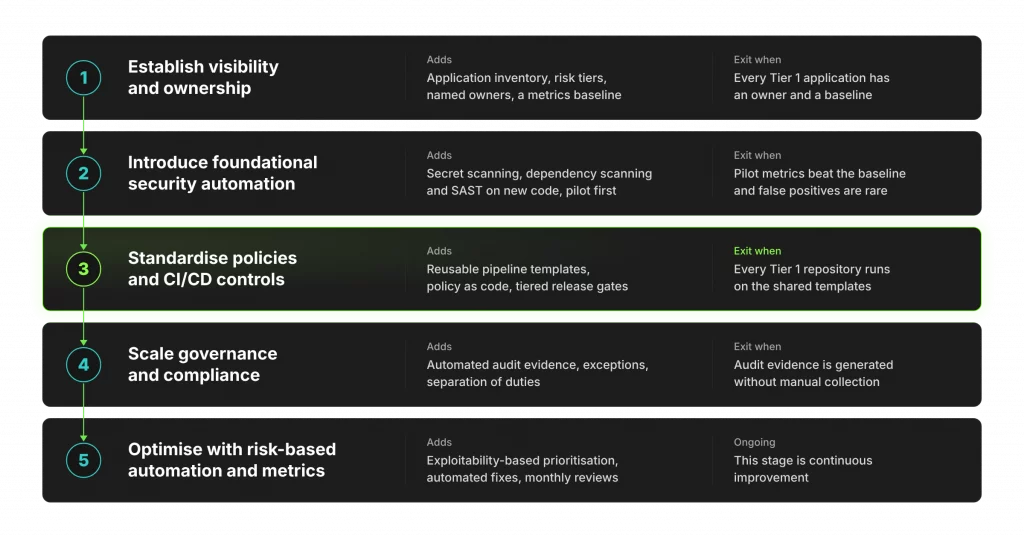
Stage three is highlighted because it is the minimum target for every Tier 1 application.
A DevSecOps adoption roadmap rarely runs in a straight line. Teams can sit at different stages, as long as every Tier 1 application reaches stage three before lower tiers move past stage two.
How Long Does DevSecOps Implementation Take?
No single figure holds across companies. Duration depends on portfolio size, DevOps maturity, the share of legacy systems, regulatory scope and team structure.
It helps to think in three phases:
- A pilot with one team and three or four controls, measured against the baseline.
- Initial adoption, when templates and tiered policies reach every Tier 1 application.
- Organisation-wide scaling, with every team onboarded and governance and evidence running continuously.
From our projects: on the finance platform in Step 3, the foundations plus static analysis for the first application took about eight weeks. For the legacy consumer platform in the readiness section, the plan we estimated ran in three windows: hardening within 30 days, a gated CI/CD pipeline in months one to three, and refactoring over three to twelve months.
When Should You Use External DevSecOps Expertise?
Most of this guide can be run by an internal team. Outside help pays off in five situations.
Limited Internal Security Expertise
If one security engineer serves dozens of developers, an external team can set up the templates and policies while your engineer focuses on risk decisions.
Complex Legacy Environments
Systems with no pipeline and no tests need hardening before automation can help.
Regulated Software Delivery
When auditors or a regulator will review the result, evidence and traceability have to be designed in from the start, because adding them later means reworking the pipeline.
Large-Scale DevSecOps Transformation
Rolling the model out to many teams at once needs extra capacity for onboarding, tuning and training.
Platform and Pipeline Standardisation
If every team runs its own pipeline, someone has to build the shared templates first.
A good partner leaves the templates, policies and ownership with your team. A partner who stays a permanent step in your release process has only moved the dependency somewhere else.
Kindgeek is ISO 27001 certified and has spent more than ten years building regulated fintech software with a team of 200+ engineers. On Clutch, a fintech client’s head of infrastructure credited our DevOps work with hitting their migration deadline.
Tell us about your applications and audit requirements. Kindgeek’s engineers will run the readiness assessment with you and plan a pilot your team can scale.
Talk to our DevOps team →How do you implement DevSecOps in an organisation?
Start with an inventory of applications and a baseline of security and delivery metrics. Then assign ownership, pilot a few high-value controls with one team and turn what works into shared templates and policies. The sequence matters more than the choice of tools.
How should a company start with DevSecOps?
When implementing DevSecOps for the first time, start small and measurable. Pick one actively developed, medium-risk application, enable secret scanning and dependency scanning and compare the results with your baseline after a fixed period. Leave your most complex legacy system for later.
What is the best way to implement DevSecOps?
The approaches that hold up are risk-based. They block releases only on high-confidence, high-impact findings, send everything else to the owning team with a deadline and apply stricter rules to applications handling payments or personal data. Programmes that start by buying a full tool suite tend to stall on alert fatigue.
What does a DevSecOps roadmap look like?
A typical roadmap moves through five stages: visibility and ownership, foundational automation, standard policies and CI/CD controls, governance and compliance at scale, and risk-based optimisation. Each stage should have an exit criterion, such as every Tier 1 application running on shared templates. Teams can sit at different stages at the same time.
How do you move from DevOps to DevSecOps?
Keep the DevOps pipeline you already have and add three things to it: named owners for security findings, automated controls with agreed gate rules and version-controlled policies with an exception process. The pipeline itself rarely needs replacing. What changes is who acts on its output and which results can stop a release.