


Agentic payments are payments an AI agent starts and completes for a person or a company, within limits that the person set in advance. The money still moves over existing rails such as cards, bank transfers and, for some machine payments, stablecoins. What changes is who presses “pay”, and how the merchant and the bank can tell the agent was allowed to.
That proof rests on three pieces. A mandate records what the human approved. An agent identity tells merchants and issuers which agent is acting. A policy engine checks each transaction against both before money moves.
Kindgeek teams build payment infrastructures for PSPs, EMIs and digital banks, mostly in the UK and EU. Below, we follow one agent purchase from goal to settled payment, then look at permissions, protocols, rails, risk, liability and what to build first.
Key Takeaways
- For consumer AI agent payments, the card schemes are furthest ahead, with tokenised credentials bound to one agent and accepted by existing merchants.
- In the UK and EU, open banking and variable recurring payments suit account-based agent payments, and coverage is widening. Stablecoins make most sense for sub-dollar payments between machines.
- Prompt injection is the risk payment fraud teams know least. Our view: keep limits in a policy engine outside the model, where text the agent reads can’t change them.
- Start with low limits and human approval for anything unusual, and widen autonomy once your logs show the agent behaves.
What Are Agentic Payments?
An agentic payment is a transaction an AI agent initiates on someone’s behalf, using authority granted earlier and often without the person present when it pays. Visa distinguishes three modes: the cardholder approves each purchase through the agent, the agent buys once within approved bounds, or it buys repeatedly under a standing instruction.
How They Differ From Traditional Digital Payments
At a normal online checkout, the customer confirms the amount and passes strong customer authentication (SCA). Card-on-file subscriptions let one merchant charge later for an agreed amount. An agent sits between the two. It chooses the merchant and pays, sometimes days after the instruction, so the issuer’s question changes from “did the cardholder authenticate this?” to “did the human approve this kind of purchase, from this agent, within these limits?”
How This Differs From Agentic Commerce
Agentic commerce covers the shopping journey, from discovery to checkout. Agentic payments are the layer underneath, where authorisation and settlement happen. That layer also reaches beyond shopping, to agents that pay supplier invoices or pay per call for an API.
Agent-Initiated vs. Human-Initiated Transactions
The U.S. Payments Forum adds agent-initiated transactions (AIT) to the two familiar categories. Fully autonomous payments, where no human sees the transaction before it settles, are still rare.
| Type | Who starts it | When the human consents | Authentication | Example |
|---|---|---|---|---|
| Customer-initiated (CIT) | Customer at checkout | At payment | SCA | Buying a rail ticket |
| Merchant-initiated (MIT) | Merchant, under a stored agreement | When the agreement is set up | SCA on the first payment | Gym membership |
| Agent-initiated (AIT) | AI agent | In advance, through a mandate | Agent credential plus mandate, step-up when a rule fires | Office supplies under £60 a month |
How an Agent Payment Works, Step by Step
Take one instruction an office manager might give a procurement agent: “Reorder printer toner for the Manchester office, under £60, from one of our two approved suppliers, by Friday.” The prices below are illustrative.
- The agent turns the sentence into a structured intent with an item, a price ceiling, two allowed suppliers and a deadline. If it can’t tell which toner model is meant, it asks.
- The user, or a company policy, approves a mandate for one purchase up to £60, valid until Friday. In Google’s AP2 protocol, this is the open form of a signed mandate, so any later change to the limits can be detected.
- The agent finds the toner at £52.40 including VAT from supplier A. It then signs the closed form of the mandate, which fixes the exact basket and price.
- At checkout, the agent presents its credentials, for example, a Visa Trusted Agent Protocol signature or a Mastercard Agentic Token, along with the mandate. The merchant checks that the agent is registered and the basket matches.
- It pays with a tokenised credential bound to the agent and the user, so the real card number never reaches the agent.
- Your policy engine compares the payment with the mandate, and the issuer runs its usual fraud scoring. If the price rose to £64, the payment would stop, and the agent would ask the office manager.
- On cards, the payment settles in the scheme’s normal cycle. Over Faster Payments, it settles in seconds and is final.
- The system links the mandate, basket, agent identity and authorisation code in one record, then matches it to the supplier’s invoice.
Our engineering team sees step 8 as the most important in agentic AI payments. A wrong toner order is easy to spot and fix, but a payment that can’t be traced back to its mandate and invoice is hard to defend if the purchase is disputed later, because that record is the only evidence of what the human approved. That’s why Kindgeek’s engineers would build the log and the daily reconciliation before giving any agent a wider mandate.
How AI Agents Get and Prove Permission to Pay
The IMF noted that a key challenge with agentic payments is that AI agents reason probabilistically, while payment authorisation must be deterministic. AI engineers and software developers are developing controls to address this challenge.
Consent and Payment Mandates
A mandate is the user’s approval in a form machines can check. Version 0.2 of AP2 added “Human Not Present” payments, where the agent pays later against limits the user approved in advance (Google). On cards, Visa requires the agent provider to get the cardholder’s consent and an acknowledgement that the cardholder is responsible for the agent’s actions.
| Mandate | Scope | Ends when | Asks the human when | Example |
|---|---|---|---|---|
| One-time | One purchase or a price ceiling | The purchase completes or the deadline passes | Price, merchant or item changes | The toner order above |
| Persistent | A category with a spending cap | End date or revocation | New merchant, cap reached, odd amount | Weekly groceries up to £120 |
Spending Limits, Policies and Step-Up Approval
Limits belong in a policy engine outside the model. Every AI agent payment request passes through it and comes back approved, declined or sent to a human. Our guide to AI in payments explains why Kindgeek ships every payment model behind a policy engine: auditors can read the rules as written. Common step-up triggers are a new payee, an amount over a threshold, a new country and a purchase at an unusual hour.
Know Your Agent (KYA)
Know Your Agent is KYC for the software acting on someone’s behalf: which agent this is and whom it represents. A May 2026 post on Bank Underground, the Bank of England staff blog, framed the shift from KYC to KYA and credited payments writer Dave Birch, who set out the idea with Mastercard’s Jelena Hoffart in the Journal of Digital Banking in 2025. No single KYA standard exists yet, so merchants rely on network signals such as Visa’s signed agent requests and Mastercard’s Agentic Tokens.
Revoking an Agent’s Authority
Revocation has to work in seconds, from the user’s side. The user cancels the mandate in their app, the issuer suspends the agent’s token and the policy engine refuses anything still in flight. A persistent mandate that can’t be switched off quickly is the biggest risk in this setup.
Agentic Payments Protocols Compared
Seven protocols come up in most integration talks. They mostly cover different layers, and one purchase can touch three or four of them.
| Protocol | Primary purpose | Authorisation model | Payment rails | Merchant role | Best use case |
|---|---|---|---|---|---|
| AP2 (Google, Sept 2025; FIDO Alliance since April 2026) | Prove what the human approved | Signed Checkout and Payment Mandates, in open and closed forms | Cards, bank transfers, stablecoins | Verifies the mandate | Purchases that need proof of intent |
| ACP (OpenAI and Stripe, Sept 2025) | Agent-to-merchant checkout | Scoped single-use payment token | Cards and wallets via the merchant’s PSP | Stays merchant of record | Shopping in chat assistants |
| Trusted Agent Protocol (Visa, Oct 2025) | Tell trusted agents from bots | Signed agent requests and tokenised credentials | Visa cards | Checks agent signatures | Consumer card purchases |
| Agent Pay (Mastercard, April 2025; machines June 2026) | Agent-bound card credentials | Agentic Tokens tied to the agent and its consent rules | Mastercard cards; accounts and stablecoins for machines | Accepts the token like any card | Consumer and corporate cards |
| x402 (Coinbase and Cloudflare, May 2025; now a Linux Foundation project) | Pay per HTTP request | “402 Payment Required”, then a signed stablecoin transfer | Stablecoins, mainly USDC | Prices each request | APIs, data and content |
| MPP (Stripe and Tempo, March 2026) | Payments between agents and services | Payment negotiated inside the HTTP request | Stablecoins and cards (Visa wrote the card spec) | Accepts through Stripe | Metered machine payments |
| UCP (Google with Shopify, Etsy, Wayfair, Target and Walmart, Jan 2026, per TechCrunch) | The whole shopping journey | Hands payment to AP2 and payment handlers | Rail-agnostic | Publishes catalogue and checkout | Checkout in Google’s AI surfaces |
Read the table as a stack: what is bought (UCP, ACP), proof of approval (AP2), the agent’s credential (Visa, Mastercard) and machine payments (x402, MPP). Agentic payment systems in production will usually support one commerce protocol, one or both card schemes and a mandate format.
Two 2026 changes matter before you plan an integration. In March OpenAI moved away from standalone Instant Checkout in ChatGPT towards merchant-owned checkout, and ACP carries on as the link between ChatGPT and merchants (Digital Commerce 360). Standards are also moving to neutral bodies, with AP2 at the FIDO Alliance and x402 at the Linux Foundation.
Send us your use case and target market. Kindgeek’s payments engineers will map the protocols and rails that fit your first agent flow.
Ask our payments engineers →Payment Rails for AI Agents: Cards, Open Banking and Stablecoins
The right rail depends on ticket size, how final the payment must be and whether the payer can dispute it. Wallets such as Google Pay sit on top of a card or bank account and inherit its properties.
| Rail | Cost | Speed and finality | Dispute route | Best fit for agents |
|---|---|---|---|---|
| Tokenised cards | Percentage fees; EU consumer interchange capped at 0.2% (debit) and 0.3% (credit) | Authorised in seconds, settled in days, reversible | Scheme chargebacks | Consumer purchases |
| Open banking and A2A (Faster Payments, SEPA Instant, VRP) | Usually a flat fee | Seconds, final | No chargebacks; UK scam reimbursement only | Bills and supplier invoices |
| Stablecoins | Low network fees | Seconds, final | None built in | Sub-dollar machine payments |
For UK and EU clients, open banking gets less attention than it deserves. Commercial variable recurring payments, where a user approves a stream of payments within set limits, went live in the UK on 2 June 2026 for utilities, financial services, charities and government, with general e-commerce due in a second wave. A VRP consent already works much like a persistent mandate, and the user’s bank handles authentication.
Stablecoins solve a different problem. Visa and Artemis counted about $15 million of adjusted x402 volume across 109.6 million transactions up to April 2026, mostly sub-dollar payments where a fixed card fee would cost more than the payment. In the EU, stablecoins that work as e-money tokens fall under MiCAR.
Most AI agents in payments will end up multi-rail, using cards for consumers, accounts for bills and stablecoins for machine traffic. Orchestration across rails then becomes the engineering problem, the same one Kindgeek covers for EU PSPs in its guide to Digital Euro integration.
Where Agents Pay Today: Consumer, B2B and Machine-to-Machine
In our view, B2B is where agent-initiated payments fit existing controls best, even though consumer shopping gets more attention. Companies already run approval thresholds and supplier lists, and an agent can work inside them.
| Use case | Typical rail | Autonomy today | Human checkpoint |
|---|---|---|---|
| Shopping and travel | Tokenised cards | Agent builds the basket | Final basket, or a tight mandate |
| Subscriptions and top-ups | Cards; VRP where the sector is covered | Repeats purchases under a cap | New merchant, cap reached |
| Accounts payable | Open banking, SEPA, Faster Payments | Matches invoice to purchase order | Over threshold, new supplier, changed bank details |
| Procurement | Virtual corporate cards | Buys from an approved catalogue | Off-catalogue items |
| Treasury | Transfers between own accounts | Moves funds within limits | Anything outside limits |
| APIs and compute | Stablecoins (x402, MPP) or Stripe | Fully autonomous per call | Daily caps per agent |
Machine-to-machine payments run with the least oversight because each one is tiny and delivered instantly. In June 2026 Mastercard extended Agent Pay to machines, with settlement in stablecoins as well as cards and accounts.
The payment flows underneath the agent are mostly familiar, and Kindgeek has built them for clients, from payabl.’s native mobile apps to a mobile payment gateway integration with PayPal for Lehrermarktplatz.
Security Risks and the Controls That Address Them
Most agent payment risks are familiar fraud risks with a new way in. Prompt injection is the exception: text the agent reads, such as a product page or an invoice, carries hidden instructions that today’s models can’t reliably tell apart from the user’s. The defence has to sit outside the model.
| Risk | What it looks like | Control |
|---|---|---|
| Prompt injection | An invoice PDF tells the agent to pay a “new” bank account | The agent can’t change payees; new payees need human approval |
| Unauthorised spending | The agent misreads “cheapest” and buys the wrong item | Mandate bound to an exact basket or ceiling |
| Credential theft | A fake agent presents a stolen card number | Agent-bound tokens and signed requests |
| Fraudulent merchants | The agent is steered to a lookalike shop | Merchant allow lists and agent verification |
| Excessive permissions | One open-ended mandate across all merchants | Short-lived, narrow mandates |
| Replay | A captured mandate is reused | Single-use tokens, expiry, one basket per mandate |
| Agent-to-agent abuse | Two agents trade to move money | Per-counterparty caps and behavioural monitoring |
The last line of defence is a kill switch. In the systems Kindgeek builds, kill switches sit in the policy layer as explicit rules, so a risk team can stop an agent without a code release.
Who Is Liable When an AI Agent Makes a Payment?
Liability is only partly settled, so the evidence each side holds will carry a lot of weight in a dispute. This reflects the position in November 2026 and isn’t legal advice.
Card Scheme Rules
The card schemes have moved fastest. Rules from Visa make the cardholder responsible for an agent provider’s actions as if they had made the transaction themselves. Agent providers must use tokens for stored credentials, and merchants can’t make cardholders waive the right to dispute agentic transactions. Chargebacks still exist, but in our reading “my agent did it” is unlikely to be enough on its own.
UK: SCA, Consent and the 2026 Review
The UK has no agent-specific rules yet. The Payments Forward Plan from HM Treasury (February 2026) commits to updating strong customer authentication and to considering whether payments by AI agents need new rules. The FCA’s payments priorities (31 March 2026) repeat that, with consultations and policy statements planned for 2027 to 2028. Until then, existing consent and SCA rules apply, which makes a human approval step for anything outside a mandate the safer design.
EU: PSD3 and the Payment Services Regulation
PSD2 is still in force. PSD3 and the Payment Services Regulation were agreed in November 2025 and the final texts published in April 2026, but as of November 2026 they aren’t in the Official Journal. Most rules apply 21 months after entry into force (Adyen), which points to 2028, as our PSD3 migration guide explains. Until regulators say otherwise, plan for payments your agents make to follow the general consent and liability rules, SCA included.
A Short Note on the US
For teams with US customers: Regulation E treats transfers by someone the consumer “furnished” an access device to as authorised, which may cover credentials handed to an agent. The CFPB hasn’t issued guidance on AI agents, and Regulation Z still caps cardholder liability for unauthorised credit card use at $50.
How to Build an Agentic Payment System
Start narrow, with one use case, one rail, low limits and a human approving anything unusual. The diagram shows where each control sits.
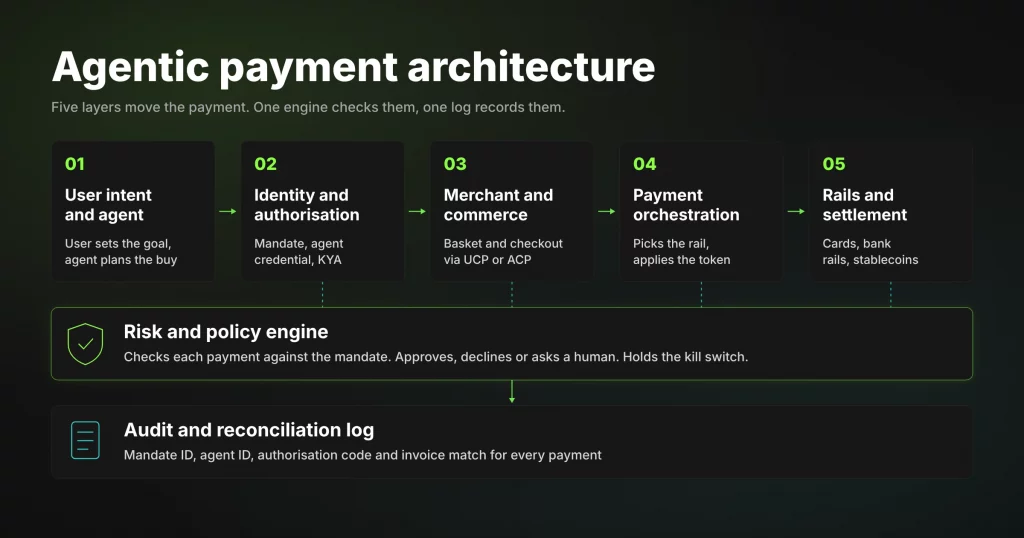
Build Steps
- Define what the agent may pay for, and what it may never do, such as change a payee.
- Design the consent model: one-time and persistent mandates, how users approve them and how they revoke them.
- Give the agent an identity. Register it with the card schemes you accept and issue agent-bound tokens.
- Pick rails and protocols for your first use case only.
- Keep limits and allow lists in the policy engine rather than the agent’s prompt.
- Decide where humans approve, and design that screen as carefully as a checkout.
- Log mandate, agent, basket and authorisation together, and reconcile daily.
- Launch with restricted limits, then widen autonomy as the data supports it.
For step 8, Kindgeek already publishes a ramp for payment models: run the model in shadow mode against live traffic for a full seasonality cycle, then expand by traffic share (5%, 25%, full volume) with a rules-only fallback. Using the same ramp for agents is our recommendation.
What to Measure
For AI agent payments, two numbers matter more than at a normal checkout: how often a human steps in, and how many payments the audit log fully explains. Track them alongside the usual set:
- completion rate from instruction to settled payment
- authorisation rate at the issuer
- human intervention rate, with the reason for each
- payments outside the mandate
- fraud and dispute rate
- latency and cost per transaction
- audit coverage, meaning payments with a complete mandate-to-invoice record
If the intervention rate falls while disputes rise, the agent has more freedom than it has earned.
What Comes Next for Agent Payments
McKinsey’s estimate that agents could orchestrate $3 to 5 trillion of global goods commerce by 2030 is a scenario, and it excludes services and B2B. The machine-payment volume Visa measured up to April 2026 was about $15 million, so most of that future is still to come.
Three problems will set the pace. Fraud models trained on human behaviour tend to read agent traffic as bots and decline good orders. A mandate signed under one protocol has to mean the same thing to every scheme and merchant that reads it, which the move of AP2 to the FIDO Alliance and x402 to the Linux Foundation should help with. Regulation is still coming too, with UK consultations planned for 2027 to 2028 and the EU’s new payment rules unlikely to apply before 2028.
Tell us what your agent should pay for. Kindgeek’s engineers will scope the mandate and controls with you, with PCI DSS and PSD2/PSD3 requirements built in from the start.
Talk to our payments team →How do AI agents make payments?
An agent pays with a credential issued to it, never the user’s raw card or bank details. Before paying, it shows the merchant proof of which agent it is and a mandate recording what the user approved. The payment then runs over an ordinary rail and passes the usual authorisation and fraud checks. Afterwards, the system logs the mandate with the authorisation, so the payment can be reconciled or disputed.
Can an AI agent spend money without human approval?
Yes, within limits, the human approved in advance. AP2’s “Human Not Present” mode and Visa’s autonomous card modes both allow it. Well-designed systems still stop and ask when a payment falls outside the mandate, for example, a new merchant or a higher price. Fully unattended spending is easiest to justify for small machine-to-machine payments, where a mistake costs cents.
How does an AI agent prove it has permission to pay?
It has to prove two separate things. Identity comes from network credentials, such as Visa Trusted Agent Protocol signatures or Mastercard Agentic Tokens bound to that agent. Permission comes from a signed mandate that records what the user approved, and any later change to it can be detected. Checking both is what people call Know Your Agent, and there’s no single standard for it yet.
Can AI agents use cards and stablecoins?
Yes, for different jobs. Tokenised cards bound to the agent are the main route for consumer purchases, because merchants already accept them and buyers keep chargeback rights. Stablecoins suit tiny, instant payments between machines, such as paying per API call through x402. In the UK and EU, open banking and variable recurring payments are a strong option for bills and supplier invoices.
Who is liable when an AI agent pays?
It depends on the rail and the country, and the rules are still being written. On Visa cards, the cardholder is responsible for their agent provider’s transactions, while dispute rights stay in place. UK consultations are planned for 2027 to 2028, the EU’s new payment rules are unlikely to apply before 2028, and the US has no agent-specific guidance. Until then, in agentic AI payments, the party holding a complete record from approval to payment is best placed, which is why Kindgeek recommends logging the mandate ID with every authorisation.