


Recently updated on August 17, 2026
AI coding assistants speed up individual tasks. AI-native engineering changes how the entire delivery pipeline works. It is an operating model in which specifications, shared context, and verification function as the primary engineering artifacts, alongside the code itself.
AI coding assistants speed up individual tasks. The bigger shift, as Kindgeek’s CTO Michael Kramarenko has argued in his article on AI-native software development, is systemic: an operating model built around shared context, agents working role by role, and human oversight.
This guide picks up that thread and works through it in practical detail: what AI-native engineering means, how it differs from AI-assisted and AI-enabled development, the principles and workflow behind it, and how to introduce it while maintaining the governance and quality control a production system requires.
We also share how Kindgeek applies AI-native engineering for regulated fintech teams, where regulatory requirements make verification and auditability mandatory.
- 01What Is AI-Native Software Engineering?
- 02AI-Assisted vs. AI-Enabled vs. AI-Native Engineering
- 03The Core Principles of AI-Native Engineering
- 04How AI-Native Engineering Reshapes the SDLC
- 05The AI-Native Engineering Workflow
- 06Specification-Driven Development and Context Engineering
- 07AI Agents and the Changing Engineer’s Role
- 08AI-Native Engineering vs. Vibe Coding
- 09Benefits and Risks of AI-Native Engineering
- 10Governance, Verification, and Measuring Performance
- 11Adopting AI-Native Engineering: Where to Start
- 12AI-Native Engineering Trends and Best Practices
- 13How Kindgeek Approaches AI-Native Engineering
- 14Conclusion
- 15Frequently Asked Questions
What Is AI-Native Software Engineering?
AI-native engineering describes a software delivery model built around AI agents that participate directly in the engineering workflow. Agents read specifications, write tests, open pull requests, and flag issues before a human reviews the diff. The defining trait is whether specifications, shared context, and verification function as first-class engineering artifacts that both agents and humans work from.
A team can adopt individual AI tools while keeping its planning, review, and release process unchanged. That’s AI-assisted development: an initial stage on the way to AI-native engineering.
AI-native engineering and building an AI-native product are different concepts. AI-native engineering describes how software gets built: the operating model of the engineering organization. Building an AI-native product describes what gets built: a product with AI features embedded in its user-facing experience. For example, fraud prevention models and conversational assistants as examples of AI use in banking.
AI-Assisted vs. AI-Enabled vs. AI-Native Engineering
McKinsey’s research on generative AI in software development identifies four levels of developer support, progressing from a developer writing every line alone to a small team guiding a coordinated system of AI agents that deliver entire applications. Three of those stages map onto the delivery models: AI-assisted development, AI-enabled workflows, and AI-native engineering.
| Model | What actually changes | Typical example |
|---|---|---|
| AI-assisted development | Individual developers use AI tools inside an unchanged workflow. Planning, review, and release stay the same. | A developer asks an AI assistant to explain a function or draft a single unit test. |
| AI-enabled workflows | AI is standardized across one workflow step, such as automated review, test generation, or documentation. The SDLC remains human-sequenced. | Every pull request runs through an AI reviewer before a human approves it. |
| AI-native engineering | Specifications and shared context drive the workflow. Agents handle defined slices of implementation, testing, and documentation. Humans own architecture, verification, and release decisions. | An agent implements a feature from an executable specification, writes its own tests, and opens a PR reviewed against acceptance criteria. |
Agentic software engineering describes the mechanism: several specialized agents coordinating on a task. AI-native engineering describes the operating model that surrounds that mechanism, including the specification discipline, governance, and verification gates needed to sustain it at production scale.
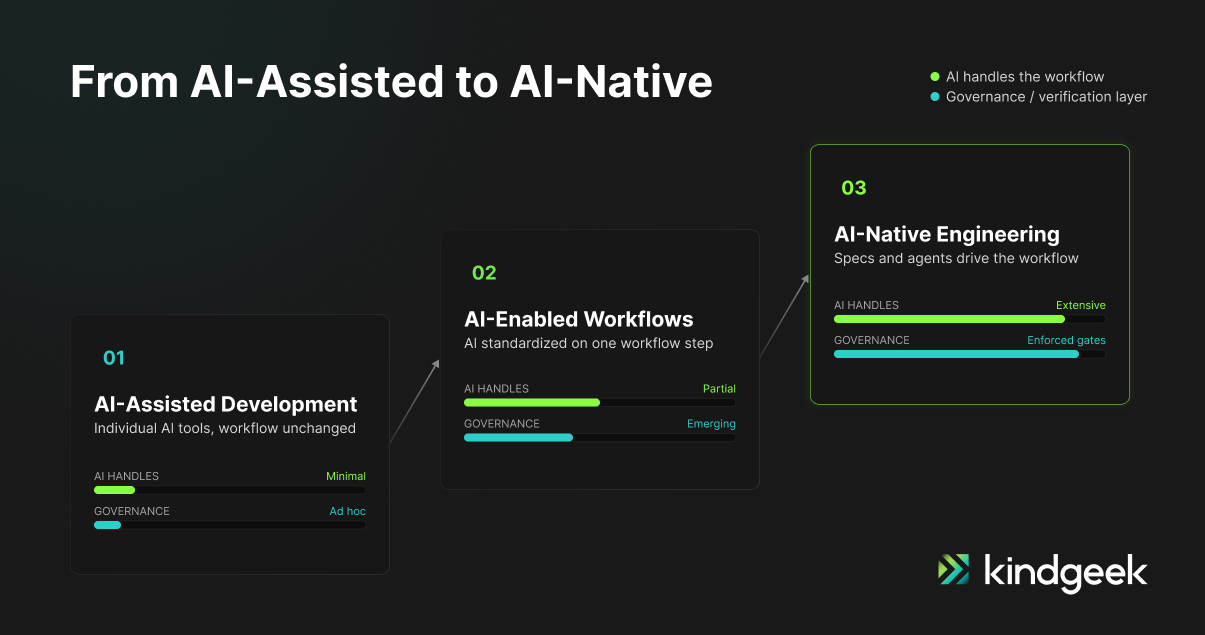
An organization can run agentic workflows on their own. AI-native engineering additionally requires specification discipline, governance, and verification gates that keep the practice reliable at production scale. This combination distinguishes a mature AI-native software engineering practice.
The Core Principles of AI-Native Engineering
AI-native engineering rests on a handful of principles that apply regardless of which models or agents a team uses:
- Intent and specifications before code. Work starts from a written, testable specification that defines expected behavior. The specification is what agents implement against and what reviewers verify output against.
- Context engineering as a discipline. Agents and reviewers need the same shared understanding of the codebase, product rules, and architectural constraints. Kindgeek’s engineering teams maintain this context as a living source of truth that gets updated continuously.
- AI agents as workflow participants. Coding, testing, review, and documentation agents each contribute from a defined role within the workflow.
- Verification before acceptance. Generated output is a proposal until it passes automated checks and human review.
- Human accountability for architecture and production decisions. Agents can propose and implement; only engineers approve what reaches production.
- Continuous feedback into the workflow. Production incidents, review comments, and test failures feed back into specifications and context, improving accuracy with each cycle.
How AI-Native Engineering Reshapes the SDLC
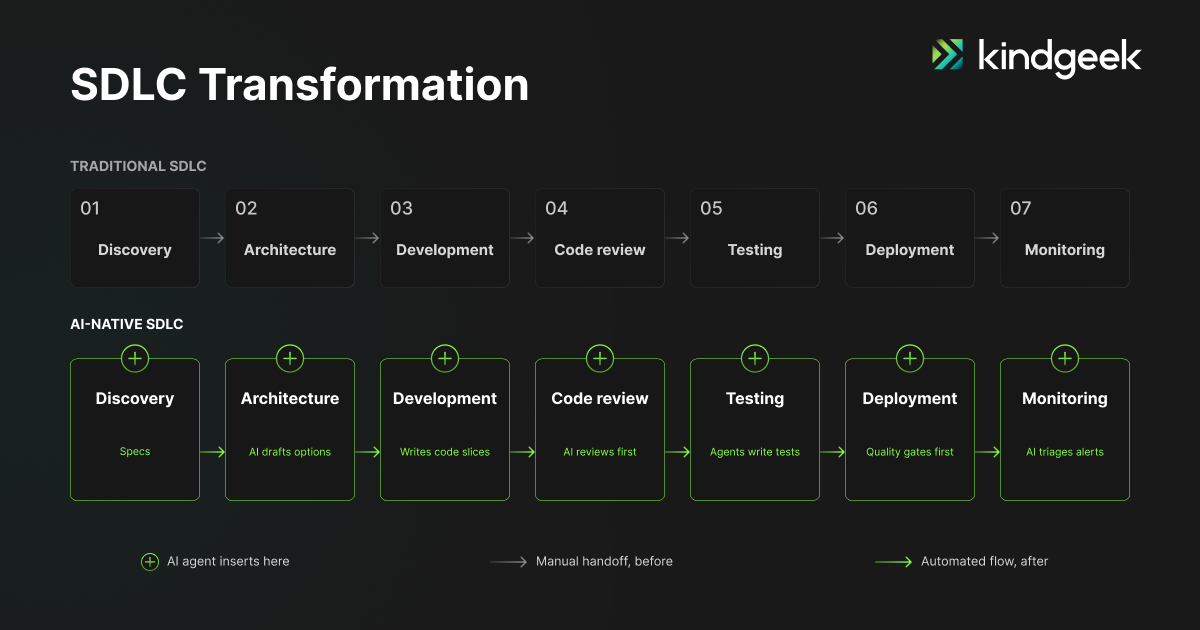
Every stage of the software development lifecycle changes shape once agents participate directly. The underlying goal of each stage stays the same:
| SDLC stage | What changes under AI-native engineering |
|---|---|
| Discovery & requirements | Requirements become structured, testable specifications that agents can implement against directly, replacing free-text tickets. |
| Architecture & design | Architecture decisions stay human-owned. Agents draft design options, flag inconsistencies against existing patterns, and keep design docs current. |
| Development & refactoring | Agents implement defined slices of work against a spec. Engineers spend more time reviewing and directing. |
| Code review & QA | AI reviewers run first, checking style, security patterns, and spec conformance before a human reviewer looks at logic and risk. |
| Testing & validation | Agents generate and maintain test suites alongside the code as it’s written. |
| Deployment & release | Automated quality gates decide whether a change is eligible to ship. Humans retain sign-off on anything touching production. |
| Monitoring & incident response | Agents triage alerts, correlate logs, and draft an initial root-cause hypothesis. Engineers own the response decision. |
Kindgeek applies this same sequence to its fintech software development work, where compliance requirements add extra weight to code review and testing.
The AI-Native Engineering Workflow
In practice, a single unit of work moves through a repeatable sequence:
- Define the task and the expected outcome in terms a reviewer can later verify against.
- Turn that intent into an executable specification: acceptance criteria, constraints, and edge cases an agent can implement against.
- Assemble the context an agent needs, including relevant code, architectural rules, prior decisions, and examples.
- Assign the work to the agent (or agents) suited to it: a coding agent, a test-generation agent, a documentation agent.
- Generate the implementation, tests, and documentation together as a single deliverable.
- Run the output through automated quality gates: static analysis, security scanning, and spec-conformance checks.
- Have a human reviewer approve the change against the original specification, then merge it.
- Feed whatever happened in production, including incidents, missed edge cases, and review feedback, back into the specifications and context for next time.
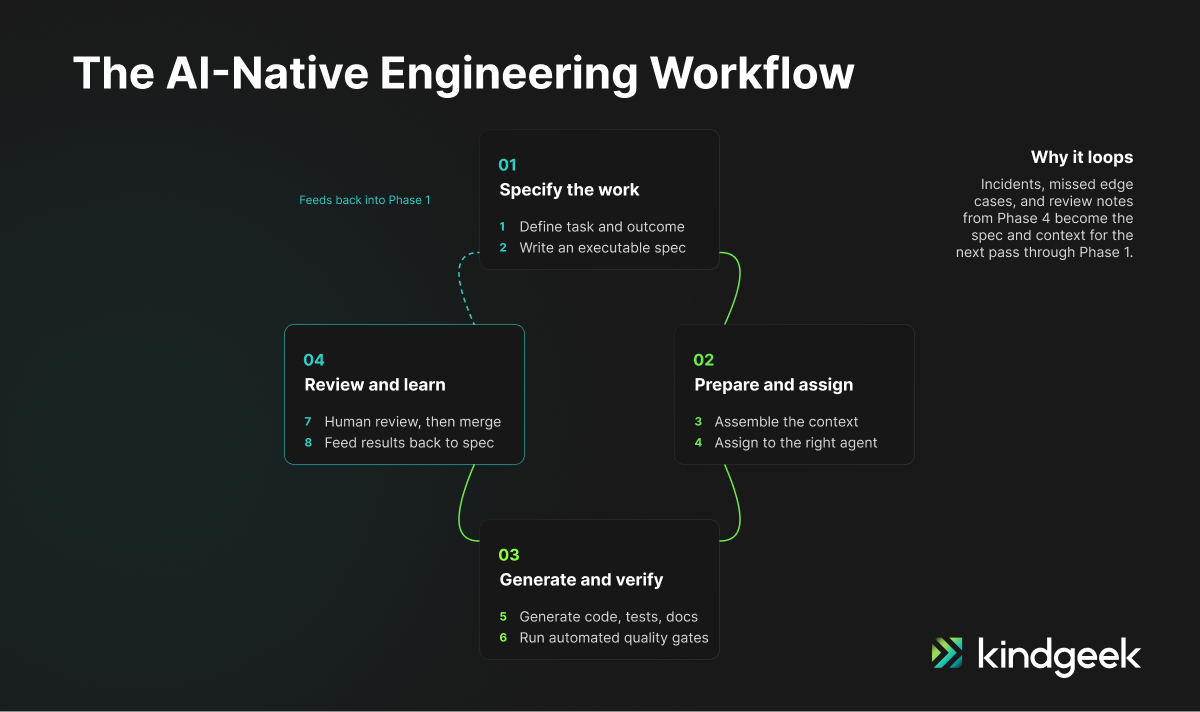
That feedback loop is what compounds the value of AI native engineering over successive tasks.
Specification-Driven Development and Context Engineering
This workflow depends on two disciplines: specification-driven development and context engineering.
In specification-driven programming, a specification is more than a natural language prompt. A prompt gives a general idea of what something should do. A specification is detailed enough for both an AI agent and a human reviewer to compare the output against acceptance criteria, constraints, and edge cases.
A practical specification defines expected behavior and acceptance criteria. It also covers technical constraints, edge cases, and failure scenarios. Specifications can become outdated as the codebase changes, so they need to stay aligned with the production code.
Context engineering ensures agents and reviewers draw on the same repository context, product and domain knowledge, security rules, and historical decisions.
Sonar’s 2026 State of Code developer survey found that AI now accounts for 42% of committed code at surveyed organizations, yet 96% of developers don’t fully trust AI-generated output to be functionally correct. Much of this comes down to context: agents working with incomplete or outdated information can produce code that looks correct but contains errors.
Managing context quality helps agents produce more reliable code and gives developers a stronger basis for review.
AI Agents and the Changing Engineer’s Role
AI-native teams often use several specialized agents:
- Coding agents implement features and changes.
- Planning and architecture agents draft designs and implementation plans.
- Testing agents create and maintain test suites.
- Security agents flag risky code, dependencies, and vulnerabilities.
- Documentation agents keep specifications and READMEs up to date.
- DevOps agents support deployments and incident triage.
The key is coordination. Each agent needs a clear role, defined scope, and consistent context. How well the agents work together matters more than the capabilities of any single model.
This also changes the engineer’s role. Instead of writing every line of code manually, engineers define requirements, set system boundaries, direct agents, and review their output. During code review, the emphasis shifts to verifying that the implementation matches the specification, tests, and anticipated functionality.
Architecture and domain expertise also become more important because someone still needs to decide what to build and whether the result meets the actual requirement.
Organizations can build these capabilities by adding engineers through team augmentation who already work with AI-native practices and can work alongside the existing team.
AI-Native Engineering vs. Vibe Coding
AI-native engineering and vibe coding are frequently conflated.
Vibe coding, a term Andrej Karpathy coined in February 2025, describes a workflow where developers describe what they want, accept AI-generated code, and iterate by feeding errors back to the model with limited review. It works well for quick prototypes and idea validation.
Production engineering needs traceability from requirements to code to tests, along with review before code reaches users. AI native engineering keeps the speed of AI generation but adds the specifications, tests, and review gates that vibe coding often skips.
The key difference is traceability: can someone identify the requirement a piece of code satisfies and the test that verifies it?
Rapid AI prototyping works well for spikes, internal tools, and early validation. The risk comes when prototype code reaches production without the specification, testing, and review it needs.
Benefits and Risks of AI-Native Engineering
The Benefits
- Faster movement from requirements to working software, since specifications function as direct implementation input.
- Smaller handoffs across the SDLC, because agents carry a task from spec through tests within a single workflow.
- Broader test and documentation coverage, since generating tests and docs alongside code costs little extra agent time.
- Faster legacy code analysis, because agents summarize and map large codebases faster than manual review.
- Better access to institutional engineering knowledge, since context becomes reusable and shared across the team.
- Delivery capacity that grows faster than headcount.
The Risks
- Incorrect or hallucinated implementations that pass a quick read but fail on edge cases.
- Security vulnerabilities in AI-generated code. Veracode’s 2026 GenAI Code Security Report found that roughly 44% of AI code-generation tasks introduced a real security vulnerability, and the average security pass rate across the models it tested was only 56%. Verizon’s 2026 Data Breach Investigations Report found that software vulnerabilities have overtaken stolen credentials as the leading entry point for breaches.
- Dependency and software supply-chain risk, including slopsquatting: attackers registering the plausible but nonexistent package names AI coding tools sometimes generate. A USENIX Security 2025 study found that close to one in five packages recommended by code-generating models did not exist.
- Loss of codebase comprehension, sometimes called comprehension debt, when engineers approve output before fully understanding it.
- Non-deterministic agent behavior, where the same prompt can produce different results from one run to the next.
- Excessive tool and repository permissions granted to agents for convenience.
- Source code and data exposure through unvetted third-party tools.
- Vendor and model lock-in, plus uncontrolled tool sprawl across teams using separate AI stacks.
These risks are the case for building verification into the SDLC as a continuous practice throughout development.
Governance, Verification, and Measuring Performance
Verification and governance help AI-native teams manage these risks. Teams verify AI-generated code like any other code, but automate more of the process:
- Automated unit, integration, and end-to-end tests
- Static analysis and security scans on every change
- Architecture and policy checks before merge
- Dependency and license checks
- Human review for high-risk changes, especially those involving authentication, payments, or sensitive data
Governance follows the same approach. Role-based permissions control what each agent can access, while repository and data controls protect sensitive code and customer data. AI-generated changes should also be traceable to the specification and the person who approved them. Incident-response plans should account for agent-specific failures, such as an agent repeatedly modifying files.
This is similar to the layered approach Kindgeek uses for PCI DSS- and GDPR-scoped fintech systems: automate checks where possible and require human approval for changes affecting production or customer funds.
Measuring results means tracking several types of signals together:
| Category | What to track |
|---|---|
| Delivery speed | Lead time for changes, deployment frequency, PR cycle time |
| Software quality | Escaped defects, test coverage, change failure rate |
| AI workflow health | Agent task success rate, AI-code acceptance rate, human override rate |
| Cost and efficiency | Model cost per task, review time, cost of rework |
| Knowledge and team | Onboarding time, documentation coverage, developer adoption |
The first two categories map directly onto DORA’s software delivery metrics: lead time for changes, deployment frequency, and change failure rate. These remain the industry standard for measuring delivery performance.
Adopting AI-Native Engineering: Where to Start
Adoption works best as a sequence:
- Assess the current engineering baseline: test coverage, documentation quality, and how well-defined requirements already are.
- Pick a handful of high-value, low-risk workflows to pilot before attempting higher-risk workflows.
- Set security and tooling policies before agents get repository or production access.
- Improve documentation and repository context, since that’s what agents will actually work from.
- Introduce specification-driven development on the pilot workflows.
- Run the pilot with real quality gates in a production-representative environment.
- Add automated evaluation so agent output quality gets measured, not assumed.
- Train engineers to orchestrate and verify agents, a skill distinct from writing code alone.
- Scale what worked to more teams once the pilot has held up under real production load.
- Keep measuring quality, cost, and risk as the practice scales.
Good starting points have one thing in common: a clear specification and a fast, low-cost way to verify the output. Test generation and maintenance, technical documentation, legacy code analysis, small feature development, dependency upgrades, and incident runbooks are good examples.
Test automation is a practical starting point in regulated environments, too. On a MiCAR-regulated crypto-fiat platform, Kindgeek used AI to build CI/CD test automation before moving on to feature development.
AI-native engineering is a poor starting point when the basic foundation is not ready. Automated testing, clear requirements, documented architecture, secure access to source code, and strong review processes all need to be in place. High-risk workflows may also require tighter human oversight. Addressing these gaps first creates a stronger foundation for AI-native engineering.
AI-Native Engineering Trends and Best Practices
Several trends are shaping AI-native engineering as the discipline matures:
- Multi-agent orchestration: Specialized agents handle coding, testing, security, and documentation within a coordinated workflow.
- Context engineering: Teams are treating context as a discipline of its own, with dedicated tools for managing the information agents need.
- Earlier governance: Access controls, permissions, and audit requirements are being established before agents get access to repositories.
- Maturity models: Teams can use maturity models to assess their progress from traditional development to optimized multi-agent delivery.
How Kindgeek Approaches AI-Native Engineering
Kindgeek applies these principles to its own delivery model. As an AI-native engineering partner for regulated fintech teams, it focuses on shared context, clearly defined agent roles, and human approval for changes that affect production, compliance, or customer funds.
Its AI accelerated engineering practice also helps fintech teams build AI features and agentic workflows into existing products.
For banks and fintechs considering external support, Kindgeek offers a practical checklist for choosing an AI implementation partner with key criteria to evaluate.
Conclusion
AI-native engineering is less about giving developers more AI tools and more about changing how software gets built and verified. The teams that benefit most are not simply generating more code; they are creating a system where agents have clear instructions, enough context to work reliably, and strong checks around their output.
The starting point is to choose a workflow where the value is measurable, define the specifications and controls around it, and use the results to decide what to scale. As those practices become reliable, teams can expand AI use without giving up control over quality, security, or production risk.
Ready to Move Toward AI-Native Engineering?
Kindgeek helps fintech engineering teams move from controlled AI pilots to governed AI-native delivery.
Contact usHow is AI-native engineering different from AI-assisted development?
AI-assisted development means individual engineers use AI tools inside an unchanged workflow: the same tickets, review process, and release steps as before. AI native engineering changes the operating model itself. Specifications and shared context become the primary inputs agents work from. Agents take on defined slices of implementation and testing, and verification happens before acceptance. The difference is structural.
Is AI-native engineering the same as vibe coding?
No. Vibe coding, the term Andrej Karpathy coined in 2025, describes accepting AI-generated code with limited review and letting a codebase grow with partial human comprehension of it. It fits rapid prototyping. AI-native engineering uses the same AI-generation speed and adds specifications, automated tests, and human review gates. The distinguishing factor is traceability: whether someone can point to the requirement a change satisfies and the test that proves it.
Does AI-generated code still require human review?
Yes. AI-generated code can look correct while still containing bugs, security flaws, or logic that doesn’t match the actual requirement. AI native software engineering routes generated code through automated quality gates and, for higher-risk changes, a human reviewer, as a standard step before acceptance.
What is specification-driven development?
It’s the practice of starting implementation from a written, testable specification that states expected behavior, machine-checkable acceptance criteria, relevant architecture and coding-standard constraints, and the edge cases the feature has to handle. Both AI agents and human reviewers work from the same specification, which makes it possible to verify that generated output satisfies the requirement.
How can an enterprise start adopting AI-native engineering?
Start by assessing the current baseline: test coverage, documentation quality, and how clearly requirements are already specified. Then pick a small number of low-risk, high-value workflows to pilot, such as test generation or legacy code analysis. Set security and access policies before agents get repository access. Measure the pilot against real delivery and quality metrics, then scale the workflows to more teams.