


Recently updated on July 31, 2026
A cross-platform framework choice carries different stakes in fintech than in a typical consumer app. A layout bug in a shopping app might cost a bad review. The same bug in a balance screen or a KYC upload flow can cost user trust, risk a failed compliance review, or delay a release.
Cross-platform frameworks are often recommended for fintech mobile UI, but the more useful question is when a team needs a Flutter fintech UI kit rather than just the framework itself.
UI inconsistency between iOS and Android versions of a banking app can lead to support tickets and compliance questions. For example, mismatched spacing on a transfer screen or a KYC step that behaves differently per platform. Data-heavy screens, security flows, and white-label requirements also change what matters here compared to a typical mobile build.
This article works through five practical criteria fintech teams use to evaluate Flutter, then covers where it genuinely struggles and what a dedicated fintech UI kit needs to include.
- 01What Fintech Teams Actually Need From a Mobile UI Framework
- 02How Flutter Performs Against the Five Fintech UI Criteria
- 03Where Flutter Struggles in Fintech
- 04Real Fintech Products Built With Flutter
- 05What Flutter Does Not Provide Out of the Box
- 06What to Look for in a Flutter Fintech UI Kit
- 07When Flutter Is (and Is Not) the Right Choice
- 08Conclusion
- 09FAQ
What Fintech Teams Actually Need From a Mobile UI Framework
Teams evaluating a Flutter UI kit for fintech can often start from a similar set of five requirements, regardless of whether they’re building a neobank, a payments app, or a crypto wallet.
Consistent UI Across iOS and Android
Visual consistency protects brand integrity and keeps regulated user flows, like consent screens and fee disclosures, implemented identically on both platforms. A predictable layout can also mean QA only needs to validate one set of behaviors instead of two.
Performance on Data-Heavy Screens
Transaction lists, investment dashboards, live balances, and real-time market feed charts all render and update constantly. A framework that can’t handle this smoothly can turn the app’s highest-traffic screen into its worst one.
Fast and Coordinated Compliance Releases
A disclosure change or a KYC field update has to reach iOS and Android at the same time. Two codebases drifting out of sync during a compliance release is a genuine business risk, not just an engineering inconvenience.
Flexible Theming and White-Label Support
Multiple brands, dark mode, and regional configurations all need to draw from the same reusable design tokens instead of forked, hand-maintained styling per brand.
A Mature Financial App Ecosystem
Biometrics, secure storage, charting, deep links, WebSockets, and payment or wallet integrations all need to exist as maintained packages, not custom-built from scratch on every project.
Not every Flutter UI library for fintech apps is built with these five in mind, which is worth stating before comparing any specific product.
How Flutter Performs Against the Five Fintech UI Criteria
Flutter Delivers Predictable Cross-Platform UI Consistency
Flutter renders its own UI instead of wrapping native platform components, which is the core mechanical reason it behaves consistently across iOS and Android. Flutter’s framework-controlled rendering pipeline, with Impeller as the default renderer on modern iOS and Android devices, gives teams direct control over how interfaces are drawn across platforms.
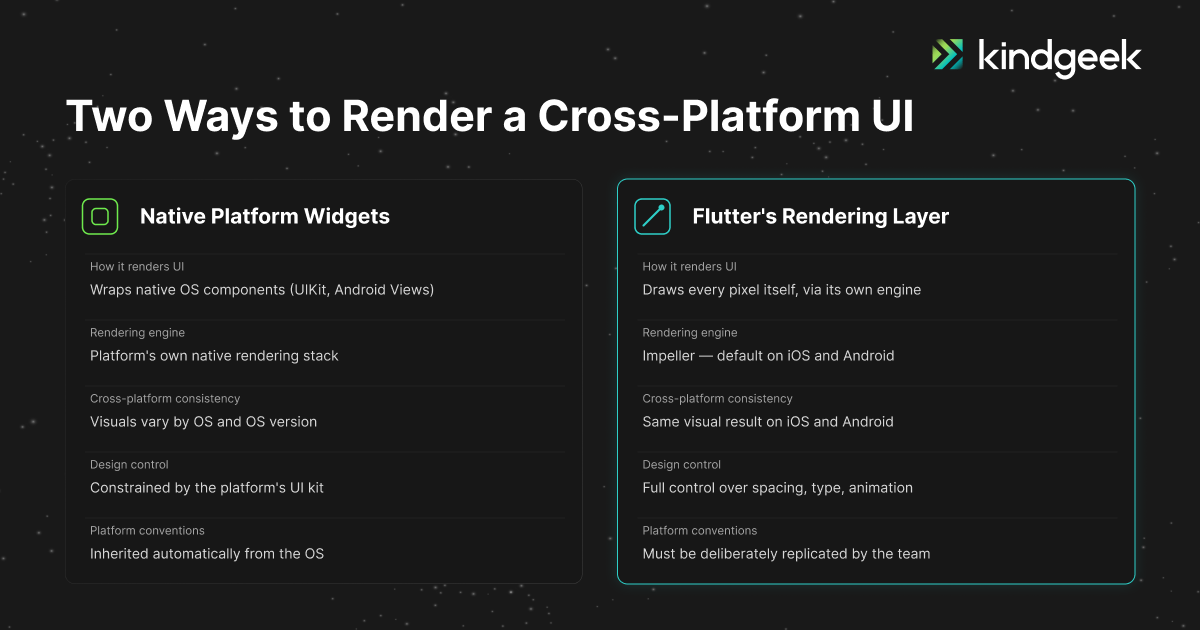
That’s a meaningfully different claim than saying every pixel is identical: visual consistency means spacing, typography, colors, and component states behave the same way by design, while interaction patterns remain platform-adaptive.
A well-engineered Flutter app uses shared design tokens for visual identity, but relies on platform-aware widgets to respect iOS and Android navigation, gestures, and system dialogs.
Flutter Can Handle Transaction Lists, Charts, and Live Data (When Engineered Correctly)
Handling thousands of transaction rows or a live-updating chart smoothly isn’t automatic. It depends on how the screen is built. A few techniques do most of the work:
- Lazy rendering through ListView.builder keeps off-screen rows out of memory.
- const widgets and scoped state prevent unnecessary rebuilds.
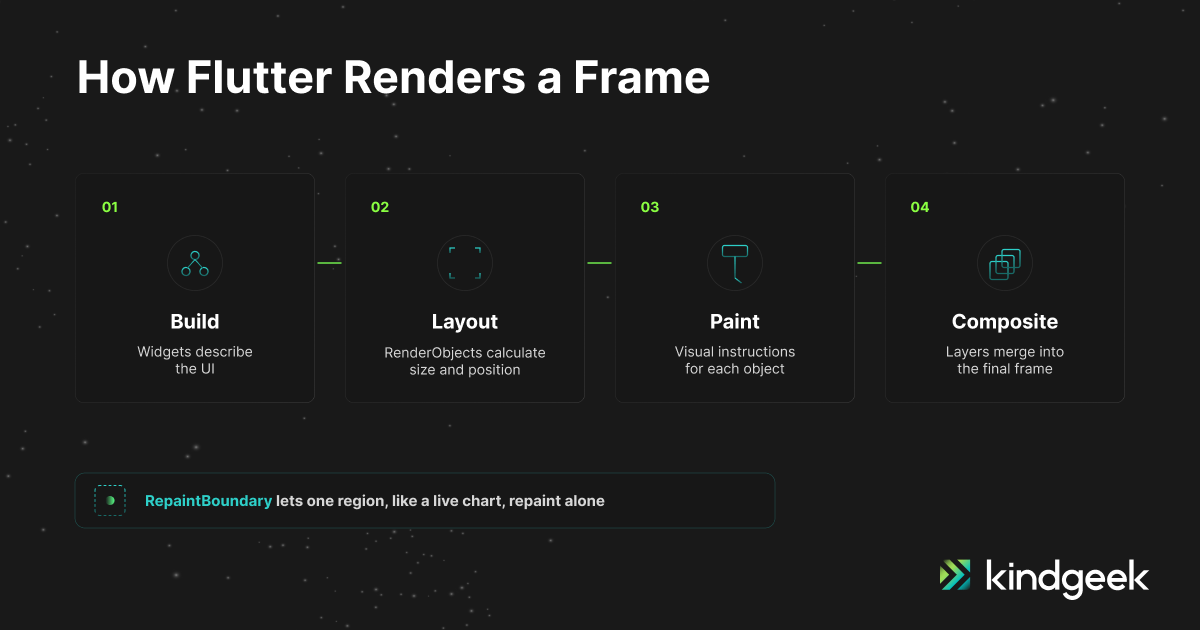
- RepaintBoundary isolates frequently updated regions, like a live chart, from the rest of the layout. But only where profiling shows it actually helps.
Testing should also happen in profile or release builds. Debug builds run noticeably slower, so they don’t give a realistic read on real-world performance.
A transaction screen with several thousand records should render only the visible rows, isolate frequently updated chart areas, and avoid rebuilding the entire page every time a live balance changes.
None of this happens by default. Flutter can hit 60 or 120 fps on modern hardware, but that’s a target the team engineers toward through profiling on physical devices, not a guarantee the framework hands over for free.
One Codebase Improves Compliance Release Velocity
A single codebase means a disclosure update, a consent screen change, or a new KYC field ships to both platforms in the same release. Centralized tests and shared business logic reduce the risk of iOS and Android behaving differently on the same regulated flow. Regulatory changes reach users faster because there’s only one implementation to update.
A single codebase doesn’t eliminate platform-specific testing, though. iOS and Android still need their own QA passes, since rendering, permissions, and store review requirements diverge even when the underlying Dart code is identical.
Material 3 and ThemeExtension Support Scalable Fintech Theming
Material 3 is a solid starting point: a modern, well-maintained component architecture. ThemeData handles the global theme configuration. ThemeExtension goes a step further, letting teams add their own typed theme properties, things like a specific “positive balance” green or a brand’s exact card-shadow radius, that Material 3 doesn’t define on its own.
Combined, this becomes the foundation of a Flutter fintech design system that can support light and dark themes, brand switching, and regional visual differences without a parallel, incompatible theming layer running alongside Flutter’s own.
Compile-time design token generation takes this a step further: instead of parsing a JSON theme file at runtime, approved design tokens compile into typed Dart classes before the app ever launches, which removes both a startup performance cost and a category of runtime theming bugs.
Kindgeek’s guide to building a fintech design system covers how tokens, components, and governance fit together beyond just the Flutter layer.
For teams specifically running one Flutter codebase across several client brands, Kindgeek’s approach to white-label Flutter app development with a token pipeline like this is what keeps a new brand a configuration change instead of a fork.
Flutter Has a Mature but Uneven Fintech Package Ecosystem
Few of the packages fintech teams reach for most often were purpose-built as fintech components for Flutter. They’re general-purpose packages that need fintech-specific configuration on top. None of them ships as a single, ready-made fintech SDK for Flutter:
- local_auth handles biometric and device authentication. It’s maintained under the flutter.dev verified publisher, updated within the last month as of this writing, and covers Android, iOS, macOS, and Windows.
- flutter_secure_storage covers encrypted storage for sensitive data like tokens and credentials. Its publisher (steenbakker.dev) is verified, the package sees regular releases, and it supports Android, iOS, macOS, Windows, and Linux.
- fl_chart handles financial charts and data visualization. It’s published under the verified flchart.dev publisher, actively maintained, and works across all major Flutter targets including web.
- web_socket_channel provides the real-time data connections transaction feeds and live pricing need. It’s maintained by the Dart team under the tools.dart.dev publisher and has recently moved to build on top of the newer package:web_socket adapter.
- reown_appkit is the current package for wallet connection and transaction signing, replacing the deprecated walletconnect_flutter_v2 after WalletConnect’s rebrand to Reown. It’s actively updated and worth watching closely, since crypto tooling in this space moves faster than most fintech dependencies.
None of this is a recommendation to add these packages without a technical review. Each one needs the same maintenance and security check any dependency handling money, identity, or credentials deserves before it ships to production. Kindgeek’s engineers run this exact kind of dependency review before any package touching money or identity reaches a client build.
Where Flutter Struggles in Fintech (and How Teams Mitigate the Risks)
Some Banking and Payment SDKs Remain Native-First
Niche payment processors, card provisioning, NFC, device attestation, and certain identity-verification SDKs are frequently released for Swift and Kotlin first, with a Flutter wrapper arriving later or not at all. Teams mitigate this with platform channels, native wrappers, Flutter’s Add-to-App capability, hybrid modules, or by working directly with the SDK vendor to confirm Flutter support before committing to a timeline.
Package Maintenance Creates Supply-Chain Risk
An abandoned package, an outdated native dependency, or an unresolved security issue in a dependency tree can become the team’s problem the moment it ships. Breaking changes in a Flutter release can also surface across a large dependency footprint all at once. A few practices reduce this risk:
- Vet packages before adopting them.
- Stick to verified publishers.
- Pin dependency versions.
- Run automated vulnerability scans.
- Review source code for anything security-sensitive.
Internal forks should stay a controlled exception, not the default response to an abandoned package.
Flutter Web Is Not Automatically Equivalent to Flutter Mobile
Flutter Web renders through a canvas-based approach rather than real DOM elements, which affects browser-specific rendering, accessibility, text selection, and SEO. Large data tables and complex desktop-style interactions also behave differently than on mobile.
None of this rules out Flutter Web for an authenticated dashboard or internal tool. It does mean evaluating the web separately, rather than assuming mobile-first decisions carry over directly.
| Flutter Is Ideal When | Flutter Struggles When |
|---|---|
| Unified brand identity with platform-adaptive UI/UX | Native-only SDKs (NFC, card provisioning, identity checks) |
| Frequent, synced releases across platforms | Uneven package maintenance on critical dependencies |
| Complex, custom UI components | Mature native codebase, no appetite for a rewrite |
| White-label or multi-brand roadmap | iOS and Android require fundamentally split product journeys |
| Team can absorb native integrations when needed | Public, SEO-facing web pages |
| Shared design system across mobile and web | Flutter limited to a few isolated modules |
Real Fintech Products Built With Flutter
Beyond Kindgeek’s own client engagements, three publicly documented examples show what these five criteria look like at production scale.
Nubank
Nubank, the largest independent digital bank outside Asia, adopted Flutter to scale mobile development without maintaining fully separate native teams. The unified engineering workflow gave the company one UI consistency standard and one internal design system instead of two. New engineers reportedly contribute to the app within days of onboarding rather than weeks.
This is one of the most cited examples of Flutter banking app development at production scale, documented directly on Flutter’s own showcase.
Google Pay
Google rebuilt Google Pay in Flutter after proving the concept with three engineers, then scaling to roughly 150 engineers as the rewrite expanded from a Singapore beta to India and the US. The move unified Android and iOS development under one codebase, cut the app down by around 35% in code size, and reduced feature development effort considerably.
A rewrite at this scale also meant repeating security reviews on a product that was already live and regulated. We advise planning for that cost in any similar migration.
SoFi
SoFi runs its “financial super app,” spanning banking, investing, budgeting, credit, and insurance, on a Flutter monorepo exceeding two million lines of code with more than 150 contributors shipping weekly releases, according to SoFi’s own engineering team. The company has since layered a package-based, unified design system on top of that Add-to-App-era foundation, an approach that reduces duplicated UI work across five separate business units within one team.
What Flutter Does Not Provide Out of the Box for Fintech UI
Flutter ships a framework and a set of general-purpose widgets but not a fintech product layer. A default install is missing the pieces every financial workflow needs, including:
- Transaction history views, account and wallet cards, and token selectors
- KYC steps and card controls
- Exchange interfaces and portfolio widgets
- Gas fee presentation and payment confirmation states
- Security states and compliance disclosures
- Empty, error, and loading states
A useful way to frame this: generic Flutter components may cover the foundational 30% of a fintech interface, while the remaining 70% consists of product-specific workflows, states, architecture, and compliance-sensitive interactions. That split is a conceptual framing based on how this work typically distributes, not a measured industry benchmark, but it’s broadly consistent with what fintech engineering teams can encounter once they start building past the login screen.
A fintech UI kit built with Flutter exists specifically to close that 70%, rather than leaving every team to rebuild the same wallet card and KYC form from scratch.
What to Look for in a Flutter Fintech UI Kit
Kindgeek’s FinKit Flutter fintech UI kit is one example built specifically around the checklist below. But you can use the criteria to evaluate any Flutter fintech component library.
Material 3 and ThemeExtension-Based Architecture
Confirm the kit builds on current Material 3 foundations, integrates custom tokens through ThemeExtension rather than a parallel styling system, and doesn’t lock the product into an incompatible theming architecture that fights Flutter’s own defaults down the line.
Compile-Time Design Tokens and Figma-to-Dart Workflow
A Flutter design token pipeline should move approved Figma variables into typed Dart code automatically, not leaving designers and engineers to sync colors and spacing by hand. Check whether token differences are reviewable in a pull request, and how the pipeline handles a breaking design change without a manual scramble across every affected screen.
Architecture Beyond Individual Widgets
A Flutter component kit for fintech apps needs more than visual pieces. Look beyond the widgets themselves for:
- A state-management approach such as BLoC or a comparable pattern (not the only production-ready option, but a common one)
- Dependency injection
- Navigation patterns
- Loading and error states
- Reusable data models or adapters
- Documentation, tests, and examples
White-Label and Multi-Brand Support Without Forking
The Flutter theming engine underneath needs brand-level tokens and either runtime or build-time brand configuration, light and dark themes, support for multiple logos and asset sets, and localization, all without requiring a manual merge across a dozen client forks every time the core kit updates.
Security, Dependencies, and Long-Term Maintenance
Review the kit against a few criteria:
- Its own dependency footprint
- Who owns and maintains each package
- Whether there’s a documented security update policy
- Flutter version compatibility and semantic versioning discipline
- Release notes and migration guides
- Automated tests and accessibility support
Kindgeek’s engineers treat this as the minimum bar before recommending any kit to a client. A production-ready Flutter UI kit earns that label through maintenance discipline.
A useful fintech UI kit should reduce foundational work without locking the product into an inflexible visual template. This is the same checklist Kindgeek applies internally.
When Flutter Is (and Is Not) the Right Choice for a Fintech Product
Choose Flutter When
- A single, branded design system with platform-adaptive navigation is required across iOS and Android
- iOS and Android need to evolve in lockstep, release after release
- The product has complex, custom components beyond standard form fields
- White-label architecture is on the roadmap, now or later
- The team can support native integrations when a feature genuinely needs them
- A shared design system across mobile, and possibly web, matters to the business
Consider Native or Hybrid Approaches When
- The product depends heavily on niche native SDKs without mature Flutter support
- A large share of the functionality needs NFC, specialized hardware, or OS-specific APIs
- A large, mature native codebase already exists with no appetite for a rewrite
- The iOS and Android apps require completely distinct user journeys, platform-exclusive feature sets, or separate design systems
- Flutter’s role is limited to a few modules added into an existing native app
Neither path is universally correct. Flutter fintech app development earns its advantages when brand consistency, coordinated releases, and long-term maintenance costs outweigh the native integrations it can’t avoid. For most Flutter financial app development roadmaps, this is the one decision worth getting right early.
Conclusion
Flutter answers the UI consistency, performance control, release velocity, and theming requirements that matter most in cross-platform fintech app development. What it doesn’t do is replace a product-specific component system built for transaction lists, KYC flows, and compliance states. The right kit accelerates development without giving up architectural flexibility later. That’s exactly what Kindgeek built FinKit to do.
FinKit is a production Flutter fintech UI kit built around exactly this checklist: Material 3, ThemeExtension, compile-time tokens, BLoC, and a Figma-to-Dart pipeline. Skip the foundational quarter.
Explore FinKitIs a dedicated fintech UI kit worth it over building the UI in-house?
It depends on the roadmap. A single-brand MVP with a short list of screens may not need one yet. A roadmap with several KYC-heavy flows, white-label delivery across multiple brands, or a combined fiat and crypto product changes the calculation, since the custom-build cost compounds across every one of those dimensions rather than staying fixed. Kindgeek sees this pattern repeat across client engagements: the tipping point can arrive sooner than a product team might expect.
What should a Flutter fintech UI kit include?
At minimum: fintech-specific components beyond generic widgets, an architecture layer with state management and dependency injection, a compile-time design token pipeline, working light and dark themes, documentation, test coverage, and a clear maintenance and security update policy. Flutter UI development for a regulated product depends on all of these being in place before the first screen ships, not added after the fact.
Can Flutter support white-label banking applications?
Yes, through design tokens, ThemeExtension, configurable assets, localization, and a multi-brand architecture built to avoid per-client forks. The mechanics are well established; the quality of the implementation is what determines whether adding a fifth brand is a configuration change or a multi-week engineering project.
Is Flutter better than React Native for fintech UI?
Neither wins outright. The honest comparison runs through rendering control, native ecosystem maturity for the specific integrations a product needs, the team’s existing expertise, SDK availability for niche payment or identity providers, and whether an existing codebase already favors one framework. Flutter tends to win on rendering consistency and custom UI; React Native can win when a team already has deep JavaScript expertise or heavy existing investment in that ecosystem. Kindgeek’s broader guide to Flutter mobile app development walks through this comparison in more depth, including cost ranges and a full decision matrix.
Is Flutter secure enough for fintech applications?
Flutter itself doesn’t make an application secure or insecure. Security depends on the surrounding architecture: backend design, encryption in transit and at rest, secure storage implementation, authentication flows, dependency management, and general secure development practices. A Flutter app built on solid architecture is as secure as any equivalent native build; a Flutter app built without that discipline carries the same risks a poorly built native app would.